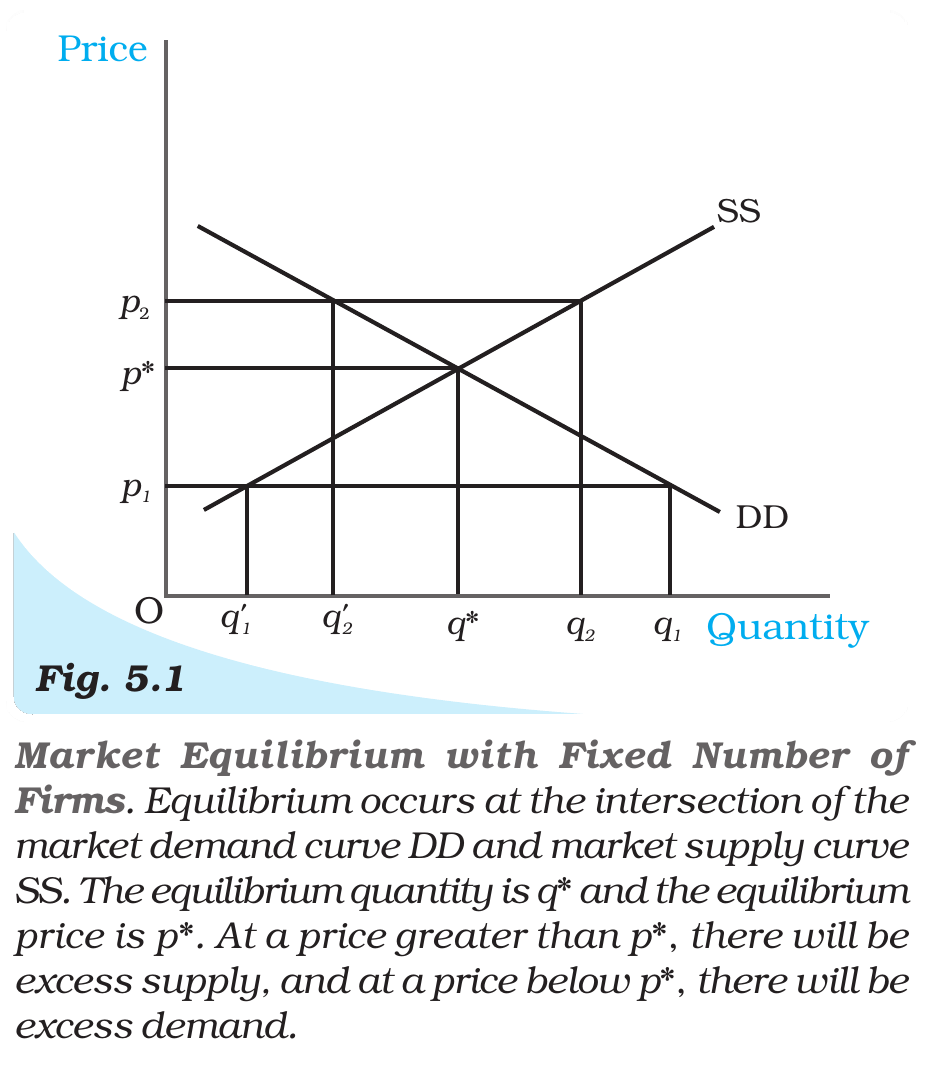
Arrange the following in correct sequence, to correct the problem of mismatch between supply and demand forces:
(A) There is excess demand in the market.
(B) All other things remain the same as price rises, quantity demanded falls and quantity supplied increases.
(C) Some consumers who are either unable to obtain the commodity at all or obtain it in insufficient quantity will be willing to pay more than the prevailing prices.
(D) The market moves towards the point where the quantity that the firms want to sell is equal to the quantity that the consumers want to buy.
Choose the correct answer from the options given below:
Answer & explanation
Correct answer: option 2
The correct answer is Option (2) → (A), (C), (B), (D)
When buyers want more than sellers offer at the going price, the price itself corrects the mismatch:
(A) There is excess demand in the market. — This is the starting problem: the quantity demanded is more than the quantity supplied.
(C) Some consumers who are either unable to obtain the commodity at all or obtain it in insufficient quantity will be willing to pay more than the prevailing prices. — Buyers who are left out offer more, so the price tends to rise.
(B) All other things remain the same as price rises, quantity demanded falls and quantity supplied increases. — The rising price narrows the gap from both sides.
(D) The market moves towards the point where the quantity that the firms want to sell is equal to the quantity that the consumers want to buy. — The rise goes on until the two quantities are equal. This point is the market equilibrium.
NCERT (2026-27): “5.1.1 Market Equilibrium: Fixed Number of Firms … To see what happens when market demand does not equal market supply, let us look in figure 5.1 again. In Figure 5.1, if the prevailing price is p1, the market demand is q1 whereas the market supply is q'1. Therefore, there is excess demand in the market equal to q'1 q1. Some consumers who are either unable to obtain the commodity at all or obtain it in insufficient quantity will be willing to pay more than p1. The market price would tend to increase. All other things remaining the same as price rises, quantity demanded falls and quantity supplied increases. The market moves towards the point where the quantity that the firms want to sell is equal to the quantity that the consumers want to buy. This happens when price is p*, the supply decisions of the firms only match with the demand decisions of the consumers.…”
|