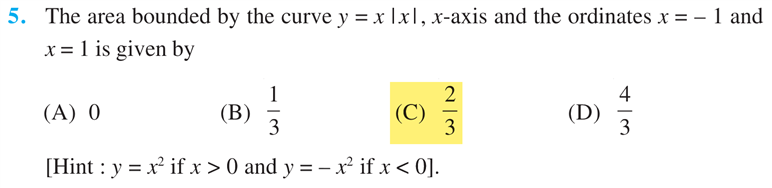
Area bounded by the curves \( y=x|x|,\ x=-1,\ x=1 \) is
Answer & explanation
Correct answer: option 2
The correct answer is Option (2) → \( \displaystyle\frac{2}{3} \) square units
Removing the modulus,
\( \displaystyle y=x|x|=\begin{cases}x^{2},&x\ge0\\ -x^{2},&x\lt0\end{cases} \)
The area bounded by the curve and the lines x = −1 and x = 1 means, as usual, the area between the curve and the x-axis from x = −1 to x = 1.
For x < 0 the curve lies below the x-axis, so that part is counted with a minus sign (integrating \( x|x| \) straight from −1 to 1 would give 0, which is not an area). The curve is symmetric about the origin, so the two parts are equal:
\( \displaystyle \text{Area}=2\int_{0}^{1}x^{2}\,dx \)
\( \displaystyle =2\times\frac{1}{3}=\frac{2}{3} \)
NCERT (2026-27 edition):
Application of Integrals