
Osmotic pressure measurements are less accurate and difficult to carry out. Therefore, this method is not useful for measuring molecular weights. But it is used to find out the molecular weights of polymers, e.g., plastics, proteins, and starch having many monomer units. Knowing the value of the osmotic pressure of a given solution, the molecular weight of the solute can be calculated using van't Hoff equation.
An aqueous solution of salt contains \(20 g\) of \(NaCl\) per liter. The pressure of the solution at \(35^oC\) will be
Answer & explanation
Correct answer: option 1
The correct answer is Option (1) → 17.29 atm
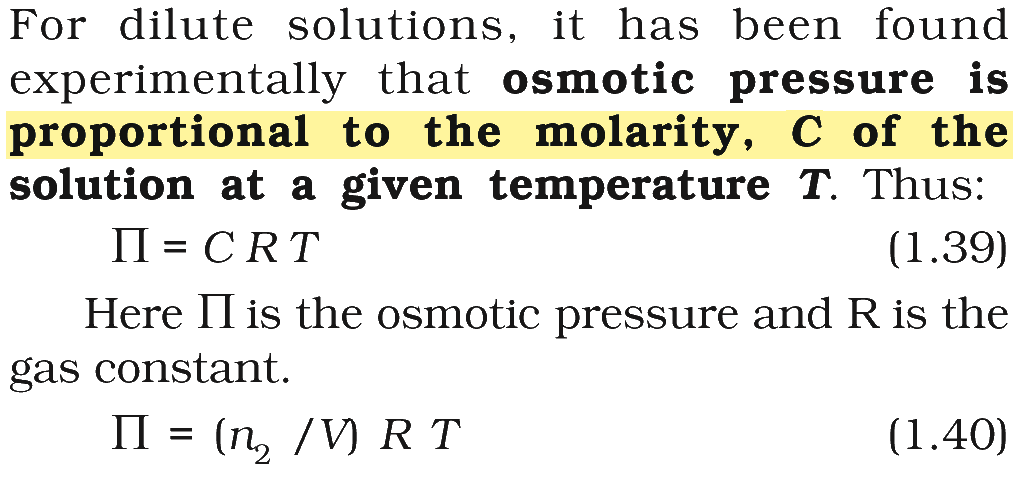
Osmotic pressure of an electrolyte solution is given by the van’t Hoff equation \( \pi = iCRT \). NaCl is a strong electrolyte and dissociates completely, \( \ce{NaCl -> Na+ + Cl-} \), so i = 2.
\( \displaystyle C = \frac{20\ \text{g}}{58.5\ \text{g mol}^{-1} \times 1\ \text{L}} = 0.342\ \text{mol L}^{-1} \)
T = 35 + 273 = 308 K, R = 0.0821 L atm K−1 mol−1
\( \pi = 2 \times 0.342 \times 0.0821 \times 308 \approx 17.29\ \text{atm} \)
The osmotic pressure of the solution is 17.29 atm.
NCERT (2026-27 edition):
Osmosis and Osmotic Pressure – …
Note: The same/similar question has been asked in different years by NTA as per the details given below:
| 2026 | 2025 | 2024 | 2023 | 2022 |
|---|---|---|---|---|
| – | – | – | 09-06 S3 31-05 S2 | – |