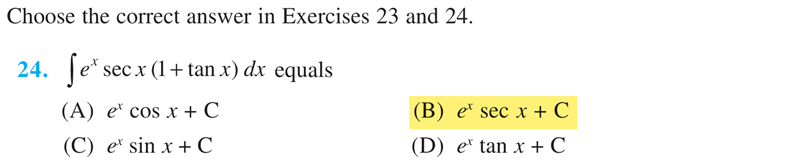
If \(\int e^{x}(\tan x + 1)\sec x\,dx = e^{x}f(x) + C\), then \(f(x)\) is:
(A) \(e^{x}\)
(B) \(\tan x\)
(C) \(\sec x\)
(D) \(\sec x\tan x\)
Choose the correct answer from the options given below:
Answer & explanation
Correct answer: option 3
The correct answer is Option (3) → (C) Only
Multiplying out the bracket:
\((\tan x + 1)\sec x = \sec x + \sec x\tan x\)
Since \(\frac{d}{dx}(\sec x) = \sec x\tan x\), the integrand has the form \(e^{x}[f(x) + f'(x)]\) with \(f(x) = \sec x\). By the standard result \(\int e^{x}[f(x) + f'(x)]\,dx = e^{x}f(x) + C\):
\( \displaystyle \int e^{x}(\sec x + \sec x\tan x)\,dx = e^{x}\sec x + C \)
So \(f(x) = \sec x\).
Checking the statements
(A) \(e^{x}\) — Incorrect. f(x) is \(\sec x\); \(e^{x}\) is the factor outside.
(B) \(\tan x\) — Incorrect. f(x) is \(\sec x\).
(C) \(\sec x\) — Correct. \(\sec x\) plus its derivative \(\sec x\tan x\) gives the integrand.
(D) \(\sec x\tan x\) — Incorrect. This is \(f'(x)\), not \(f(x)\).
NCERT (2026-27 edition):
Integration by Parts