
The products \(X\) and \(Y\) for the below reaction are:
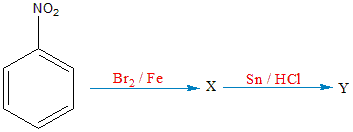
Answer & explanation
Correct answer: option 3
The correct answer is Option (3) → X = 3-bromonitrobenzene, Y = 3-bromoaniline
The –\( \ce{NO2} \) group withdraws electrons from the ring by resonance and induction. It deactivates the ring and is a meta director: in electrophilic substitution the new group enters the meta position. Sn and HCl then reduce the nitro group to an amino group, without touching the C–Br bond.
First, nitrobenzene is brominated with \( \ce{Br2} \) and Fe (Fe forms \( \ce{FeBr3} \), a Lewis acid that generates the \( \ce{Br^{+}} \) electrophile):
\( \ce{C6H5NO2 + Br2} \xrightarrow{\ce{Fe}} \ce{BrC6H4NO2 + HBr} \) (Br meta to \( \ce{NO2} \))
Then Sn/HCl reduces –\( \ce{NO2} \) to –\( \ce{NH2} \):
\( \ce{BrC6H4NO2 + 6[H]} \xrightarrow{\ce{Sn/HCl}} \ce{BrC6H4NH2 + 2H2O} \)
So X is 3-bromonitrobenzene and Y is 3-bromoaniline, which is Option (3).
Why the other options are incorrect
Option (1) 4-bromonitrobenzene and 4-bromo-2-chloronitrobenzene — Incorrect. –\( \ce{NO2} \) does not direct to the para position, and the second step is a reduction; HCl does not put Cl on the ring, and Y would still carry –\( \ce{NO2} \).
Option (2) 4-bromonitrobenzene and 4-bromoaniline — Incorrect. The reduction step is right, but the bromine is para; –\( \ce{NO2} \) is a meta director, so the para product is not the main product.
Option (4) 3-bromonitrobenzene and 1-bromo-3-chloro-5-nitrobenzene — Incorrect. X is right, but Sn/HCl reduces the nitro group; it does not chlorinate the ring.
NCERT (2026-27 edition):
Reduction of Nitro Compounds
