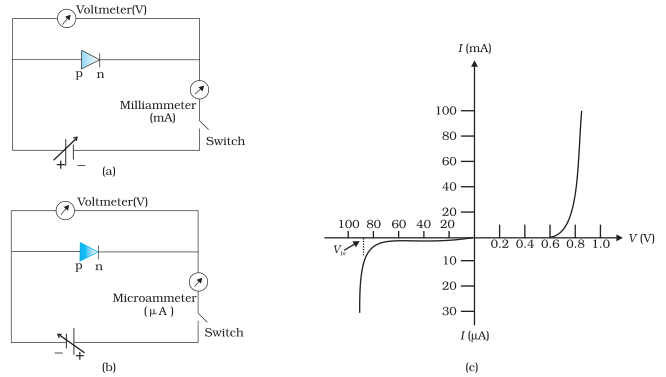
The threshold voltage (cut-in voltage) for a silicon diode is
Answer & explanation
Correct answer: option 2
The correct answer is Option (2) → 0.7 V
In forward bias a diode conducts appreciably only after the applied voltage overcomes the barrier potential. The voltage at which the current starts rising sharply is the threshold (cut-in) voltage, about 0.7 V for silicon and about 0.2 V for germanium.
Why the other options are incorrect
Option (1) 1.1 V — Incorrect. 1.1 eV is the band gap of silicon, not its cut-in voltage.
Option (3) 0.2 V — Incorrect. About 0.2 V is the cut-in voltage of a germanium diode.
Option (4) 0.5 V — Incorrect. 0.5 V is below the cut-in voltage of silicon; the current is still very small at this voltage.
NCERT (2026-27):
p-n Junction Diode Under Reverse Bias – “… You can see in Fig. 14.16(c) that in forward bias, the current first increases very slowly, almost negligibly, till the voltage across the diode crosses a certain value. After the characteristic voltage, the diode current increases significantly (exponentially), even for a very small increase in the diode bias voltage. This voltage is called the threshold voltage or cut-in voltage (~0.2V for germanium diode and ~0.7 V for silicon diode).”