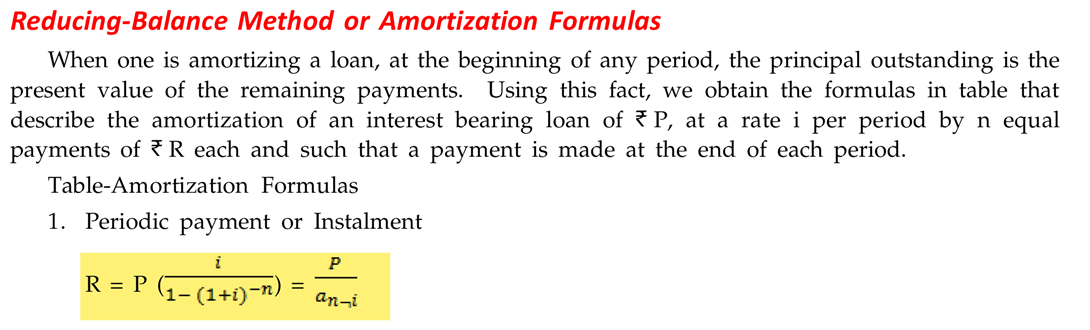
The EMI on a loan of amount Rs. P at a rate i per period for n periods is computed by:
Answer & explanation
Correct answer: option 2
The correct answer is Option (2) → \(\displaystyle\frac{P\cdot i}{1-(1+i)^{-n}}\)
The loan P is the present value of the n equal instalments E, each paid at the end of a period:
\( \displaystyle P = \frac{E}{1+i} + \frac{E}{(1+i)^2} + \cdots + \frac{E}{(1+i)^n} = E\cdot\frac{1-(1+i)^{-n}}{i} \)
(sum of a geometric progression with ratio \(\frac{1}{1+i}\)). Solving for E:
\( \displaystyle E = \frac{P\cdot i}{1-(1+i)^{-n}} \)
Multiplying numerator and denominator by \((1+i)^n\) gives the other common form \(E = \frac{P\,i\,(1+i)^n}{(1+i)^n - 1}\).
Why the other options are incorrect
Option (1) \(\displaystyle\frac{P}{1-(1+i)^{-n}}\) — Incorrect. The factor i is missing; for example with i = 0.1 and n = 1 it gives 11P instead of 1.1P.
Option (3) \(\displaystyle\frac{P}{1-(1+i)^{n}}\) — Incorrect. \((1+i)^n \gt 1\), so this is negative; an instalment cannot be negative.
Option (4) \(\displaystyle\frac{P\cdot i}{1-(1+i)^{n}}\) — Incorrect. The power must be −n; with +n the denominator is negative and so is the result.
CBSE Applied Mathematics (Class XII):
Reducing-Balance Method or Amortization Formulas