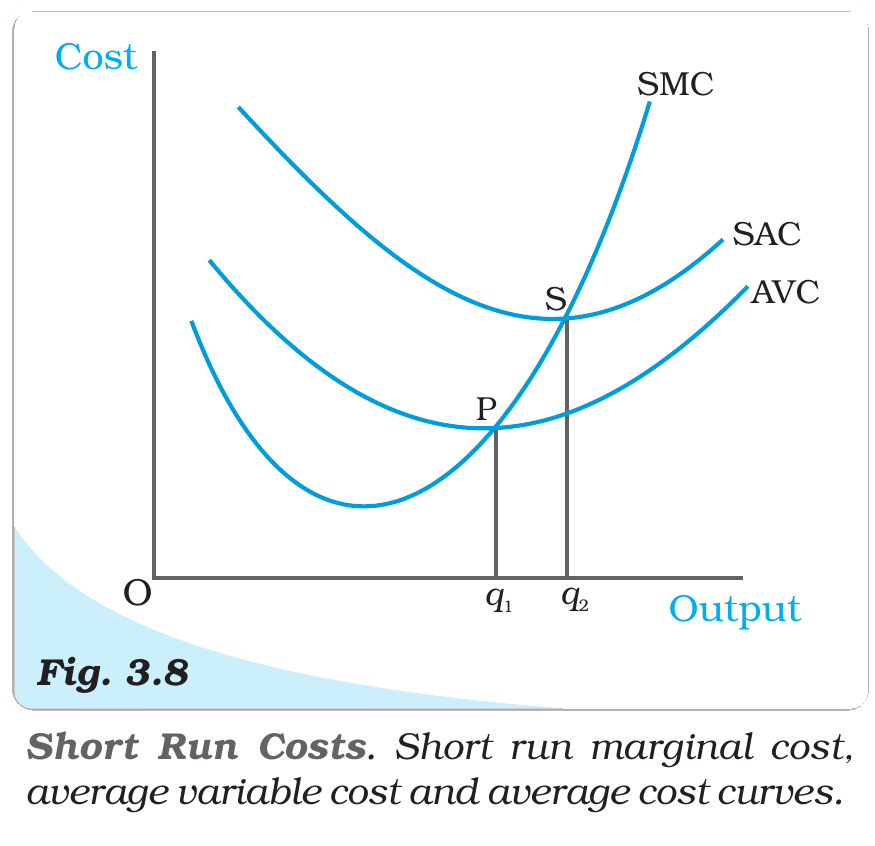
Select the correct statements from the following with regard to cost curves:
(A) Short run marginal cost, average variable cost and short run average cost curves are 'U'-shaped.
(B) SMC curve cuts the AVC curve from below at the minimum point of AVC.
(C) SMC curve cuts the AFC curve from below at the minimum point of AFC.
(D) Average fixed cost curve is downward sloping.
Choose the correct answer from the options given below:
Answer & explanation
Correct answer: option 1
The correct answer is Option (1) → (A), (B) and (D) only
(A) Short run marginal cost, average variable cost and short run average cost curves are 'U'-shaped. — Correct. Each of these costs falls first and then rises as output grows. For marginal cost, the law of variable proportions lies behind this shape: the marginal product of a factor first rises and then falls.
(B) SMC curve cuts the AVC curve from below at the minimum point of AVC. — Correct. While short run marginal cost (SMC) is below average variable cost (AVC), it pulls the average down. Once it is above AVC, it pulls the average up. So the two meet at the lowest point of AVC.
(C) SMC curve cuts the AFC curve from below at the minimum point of AFC. — Incorrect. Average fixed cost (AFC) keeps falling as output rises, so it has no minimum point.
(D) Average fixed cost curve is downward sloping. — Correct. AFC is total fixed cost divided by output. The same fixed cost is spread over more units as output rises, so AFC falls.
NCERT (2026-27): “Shapes of the Short Run Cost Curves … AFC is the ratio of TFC to q. TFC is a constant. Therefore, as q increases, AFC decreases.… …Let us now look at the SMC curve. Marginal cost is the additional cost that a firm incurs to produce one extra unit of output. According to the law of variable proportions, initially, the marginal product of a factor increases as employment increases, and then after a certain point, it decreases. This means initially to produce every extra unit of output, the requirement of the factor becomes less and less, and then after a certain point, it becomes greater and greater. As a result, with the factor price given, initially the SMC falls, and then after a certain point, it rises. SMC curve is, therefore, ‘U’-shaped. Now, what does the AVC curve look like? For the first unit of output, it is easy to check that SMC and AVC are the same. So both SMC and AVC curves start from the same point. Then, as output increases, SMC falls. AVC being the average of marginal costs, also falls, but falls less than SMC. Then, after a point, SMC starts rising. AVC, however, continues to fall as long as the value of SMC remains less than the prevailing value of AVC. Once the SMC has risen sufficiently, its value becomes greater than the value of AVC. The AVC then starts rising. The AVC curve is therefore ‘U’-shaped. As long as AVC is falling, SMC must be less than the AVC. As AVC rises, SMC must be greater than the AVC. So the SMC curve cuts the AVC curve from below at the minimum point of AVC. …Let us now look at SAC. SAC is the sum of AVC and AFC. Initially, both AVC and AFC decrease as output increases. Therefore, SAC initially falls. After a certain level of output production, AVC starts rising, but AFC continuous to fall. Initially the fall in AFC is greater than the rise in AVC and SAC is still falling. But, after a certain level of production, rise in AVC becomes larger than the fall in AFC. From this point onwards, SAC is rising. SAC curve is therefore ‘U’-shaped.…”
|