Which of the following acids has the smallest dissociation constant?
Answer & explanation
Correct answer: option 3
The correct answer is Option (3) → BrCH2CH2COOH
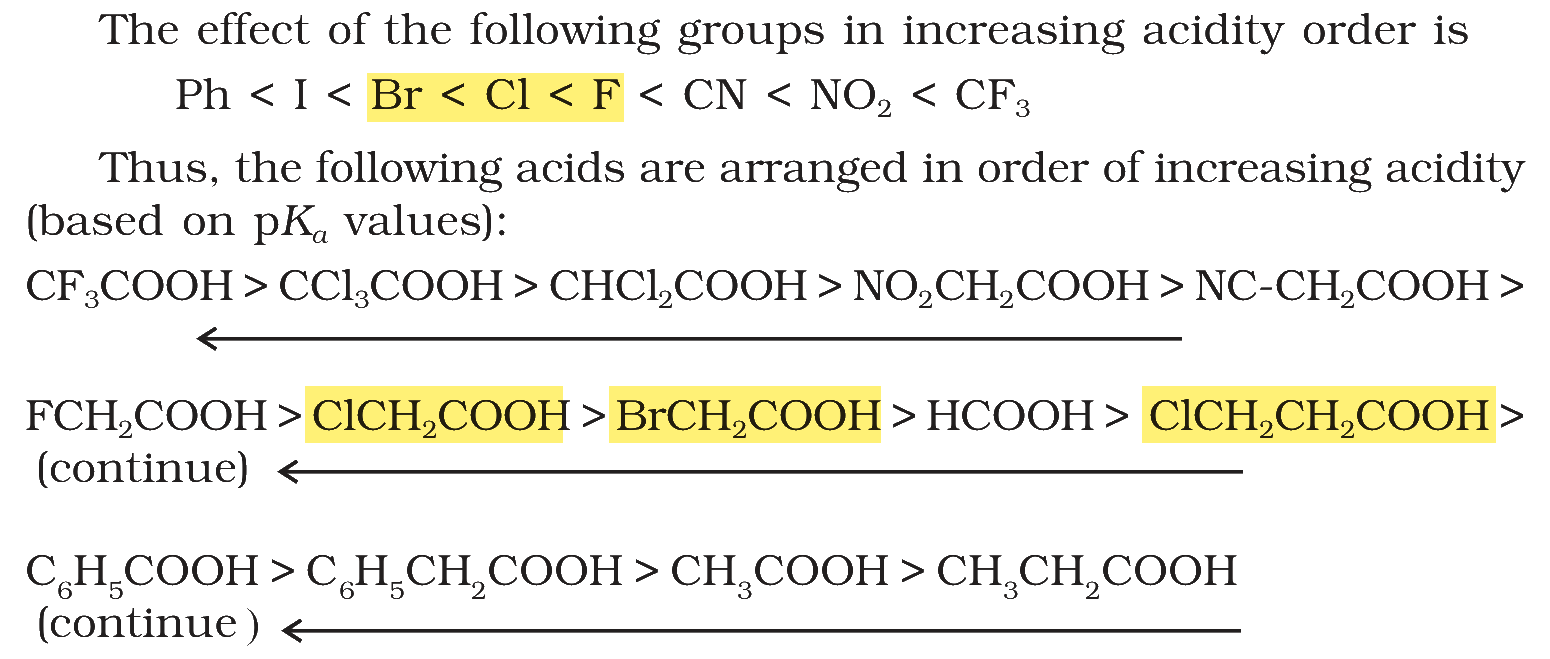
The smallest dissociation constant (Ka) belongs to the weakest acid. A halogen is an electron withdrawing group: by its inductive effect it stabilises the carboxylate ion and so increases the acidity. The effect is larger when:
the halogen is more electronegative: F has a stronger effect than Br (Br < Cl < F);
the halogen is nearer to –COOH: a halogen on C-2 (α) acts more strongly than one on C-3 (β), as ClCH2COOH is a stronger acid than ClCH2CH2COOH.
Applying both to the four acids:
\( \ce{CH3CHFCOOH} \) — F on the α-carbon: strongest pull, strongest acid.
\( \ce{CH3CHBrCOOH} \) — Br on the α-carbon: weaker than the α-F acid.
\( \ce{FCH2CH2COOH} \) — F on the β-carbon: weaker than the α-F acid.
\( \ce{BrCH2CH2COOH} \) — the less electronegative halogen, and on the farther β-carbon: weakest acid, smallest Ka.
NCERT (2026-27 edition):
8.9.1 Reactions Involving Cleavage of O–H Bond – “Effect of substituents on the acidity of carboxylic acids: Substituents may affect the stability of the conjugate base and thus, also affect the acidity of the carboxylic acids. Electron withdrawing groups increase the acidity of carboxylic acids by stabilising the conjugate base through delocalisation of the negative charge by inductive and/or resonance effects.”