
If the salt bridge connecting the two half-cells of a galvanic cell is removed, the voltage of the cell
Answer & explanation
Correct answer: option 1
The correct answer is Option (1) → drops to zero
A galvanic cell works only as a closed circuit. Electrons travel through the outer wire from anode to cathode, and the salt bridge joins the two electrolytes inside the cell, letting ions move between them.
When the salt bridge is removed, the internal connection is broken and the circuit is open. No current can flow, the cell reaction stops, and the voltmeter reads zero.
Why the other options are incorrect
Option (2) does not change — Incorrect. The salt bridge is part of the circuit; without it the two half-cells are no longer connected inside the cell.
Option (3) increases gradually — Incorrect. Breaking the circuit cannot raise the voltage; the reading falls.
Option (4) falls to half of its initial value — Incorrect. An open circuit allows no current at all, so the reading falls to zero, not to half.
NCERT (2026-27 edition):
2.2 Galvanic Cells – “… The two half-cells are connected by a metallic wire through a voltmeter and a switch externally. The electrolytes of the two half-cells are connected internally through a salt bridge as shown in Fig. 2.1.”
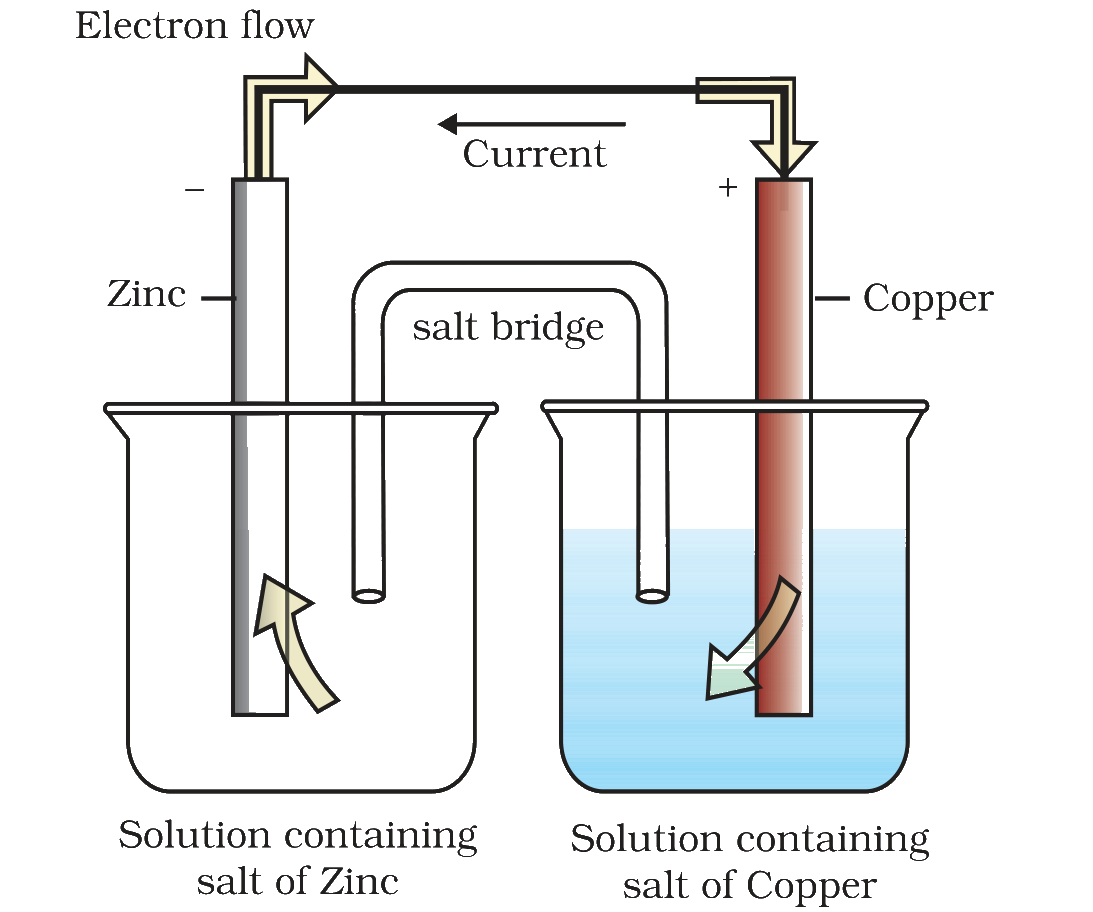
Fig. 2.1: Daniell cell having electrodes of zinc and copper dipping in the solutions of their respective salts.