Vitamins are organic compounds required in the diet in small amounts to perform specific biological functions for normal maintenance of optimum growth and health of the organism. Their deficiency causes specific diseases. Most of the vitamins cannot be synthesised in our body, but plants can synthesise almost all of them.
Vitamins are classified into two groups depending upon their solubility in water or fat. Vitamins which are soluble in fat and oils but insoluble in water are called fat soluble vitamins. These are vitamins A, D, E and K. They are stored in liver and adipose (fat storing) tissues. B group vitamins and vitamin C are soluble in water and are called water soluble vitamins. Water soluble vitamins must be supplied regularly in the diet because they are readily excreted in urine and cannot be stored (except vitamin B12) in our body.
Consider the following statements about vitamins.
(A) Excess of vitamins is also harmful, and vitamin pills should not be taken without the advice of a doctor.
(B) Deficiency of vitamin D causes osteomalacia, that is, soft bones and joint pain in adults.
(C) Deficiency of vitamin E leads to increased blood clotting time.
(D) Deficiency of vitamin A causes xerophthalmia, the hardening of the cornea of the eye.
Which of the statements given above are correct? Choose the correct answer from the options given below:
Answer & explanation
Correct answer: option 3
The correct answer is Option (3) → (A), (B) and (D) only
Vitamins are needed in small amounts: too little of a vitamin causes its own deficiency disease, and too much is also harmful.
(A) Excess of vitamins is also harmful, and vitamin pills should not be taken without the advice of a doctor. — True. More is not better: an excess of vitamins also harms the body.
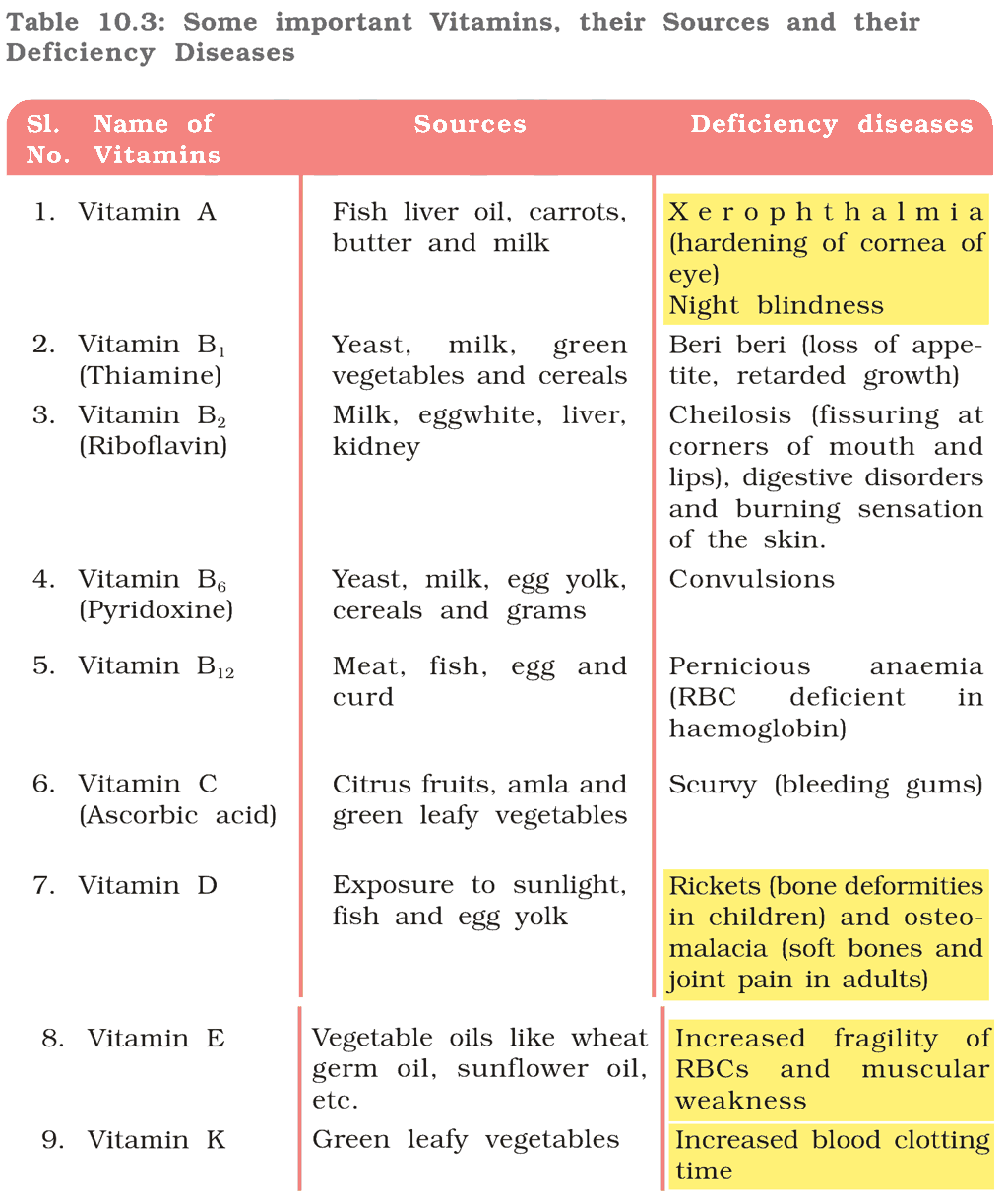
(B) Deficiency of vitamin D causes osteomalacia, that is, soft bones and joint pain in adults. — True. Lack of vitamin D causes rickets (bone deformities) in children and osteomalacia in adults.
(C) Deficiency of vitamin E leads to increased blood clotting time. — False. Increased blood clotting time is caused by a lack of vitamin K.
Vitamin E deficiency gives increased fragility of RBCs and muscular weakness.
(D) Deficiency of vitamin A causes xerophthalmia, the hardening of the cornea of the eye. — True. Vitamin A deficiency causes xerophthalmia and night blindness.
NCERT (2026-27 edition):
10.4 Vitamins – “…Excess of vitamins is also harmful and vitamin pills should not be taken without the advice of doctor.”
10.4.1 Classification of Vitamins – “…Some important vitamins, their sources and diseases caused by their deficiency are listed in Table 10.3.”
Table 10.3: Some important Vitamins, their Sources and their Deficiency Diseases