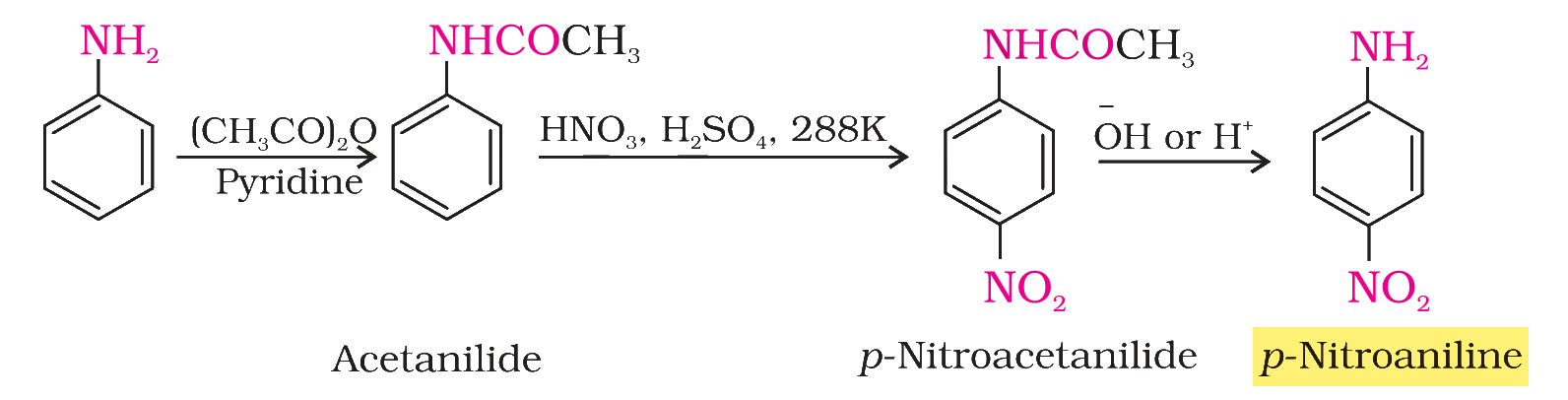
The amino group is ortho, para directing and a powerful activating group, so aryl amines undergo the typical electrophilic substitution reactions readily. In fact, the rate of these reactions is so great that in certain cases poly-substitution, rather than mono-substitution, occurs even under mild conditions. If the reaction has to be stopped at the mono-substitution stage, the activating effect of the –NH2 group has to be controlled.
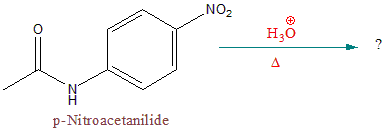
Identify the product of the given reaction.
Answer & explanation
Correct answer: option 1
The correct answer is Option (1) → p-Nitroaniline
To stop substitution in aniline at one group, the –NH2 group is first protected as the amide –NHCOCH3 (acetylation), the substitution is carried out, and the amide is then hydrolysed back to the amine. Here p-nitroacetanilide is the substituted amide, and heating with dilute acid breaks its amide C–N bond:
\( \displaystyle \ce{O2N-C6H4-NHCOCH3 + H2O} \xrightarrow[\Delta]{\ce{H3O^+}} \ce{O2N-C6H4-NH2 + CH3COOH} \)
The acetyl group leaves as acetic acid; the nitro group stays at the para position. The product is p-nitroaniline.
Why the other options are incorrect
Option (2) p-Nitrophenol — Incorrect. Hydrolysis cuts the bond between N and the acetyl group; the nitrogen stays on the ring, so no –OH group takes its place.
Option (3) Acetanilide — Incorrect. Hydrolysis removes the acetyl group, not the nitro group; acetanilide is the compound that was nitrated to give the starting material.
Option (4) Benzene-1,4-diamine — Incorrect. Turning –NO2 into –NH2 is a reduction; acid hydrolysis does not reduce the nitro group.
NCERT (2026-27 edition):
9.6 Chemical Reactions – “(b) Nitration: … by protecting the –NH2 group by acetylation reaction with acetic anhydride, the nitration reaction can be controlled and the p-nitro derivative can be obtained as the major product.”