Which among the following limits the money multiplier process?
Answer & explanation
Correct answer: option 2
The correct answer is Option (2) → Cash Reserve Ratio.
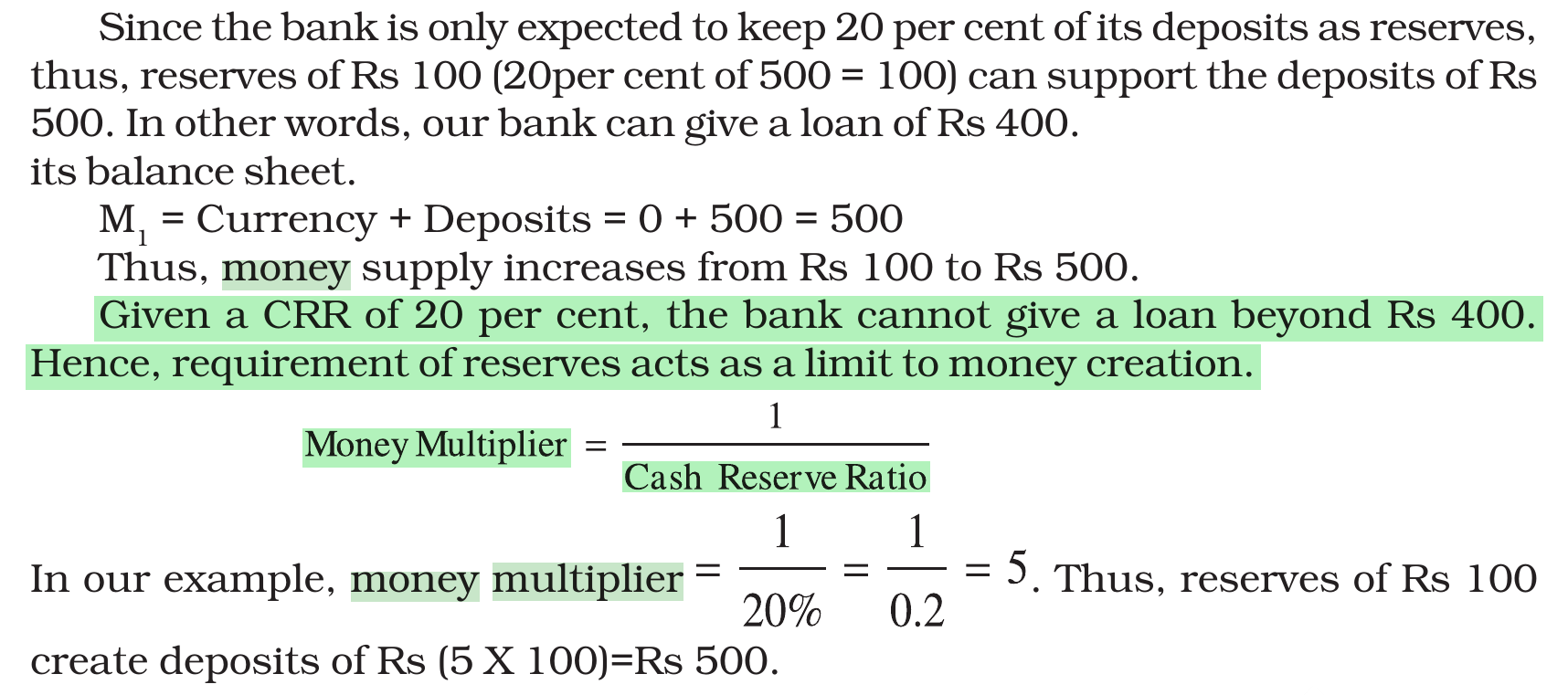
Banks lend out part of each deposit, and the loan returns to the banks as a fresh deposit, part of which is lent again. Deposits thus grow to several times the reserves; the number of times is the money multiplier. The process stops because banks must keep a share of deposits as cash, the Cash Reserve Ratio (CRR), which cannot be lent:
Money multiplier = 1 ÷ CRR
With a CRR of 20 per cent: 1 ÷ 0.2 = 5, so reserves of Rs 100 support deposits of Rs 500
Why the other options are incorrect
Option (1) Interest rate. — Incorrect. The interest rate is the price paid for borrowing money. It affects how much people wish to borrow, but the size of the multiplier is fixed by the share of each deposit that banks must hold back.
Option (3) Inflation. — Incorrect. Inflation is a rise in the price level; it is not a leakage from the lending chain.
Option (4) Unemployment. — Incorrect. Unemployment is the situation in which people who are willing to work cannot find work. It describes the labour market and does not enter the process by which deposits create loans.
NCERT: Introductory Macroeconomics — Chapter 3: Money and Banking (2025-26)
|