
Match LIST-I with LIST-II
| LIST-I Chemical Reactions | LIST-II Type of Reactions | |
| A. | 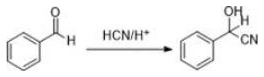 | I. Electrophilic substitution reaction |
| B. | 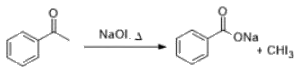 | II. Nucleophilic substitution reaction |
| C. | 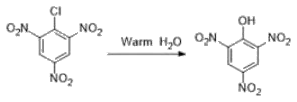 | III. Nucleophilic addition reaction |
| D. | 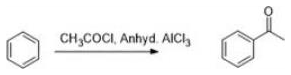 | IV. Oxidation |
Answer & explanation
Correct answer: option 3
The correct answer is Option (3) → A-III, B-IV, C-II, D-I
Organic reactions are classified by what attacks and what happens: a nucleophile adding to a C=O group, a nucleophile replacing a group on carbon, an electrophile replacing a hydrogen of a benzene ring, or a change in the oxidation level of carbon (oxidation).
A. Benzaldehyde with HCN — This matches III. Nucleophilic addition reaction. The cyanide ion adds to the carbonyl carbon and the oxygen picks up \( \ce{H^{+}} \), giving the cyanohydrin; nothing is lost.
\( \displaystyle \ce{C6H5CHO + HCN -> C6H5CH(OH)CN} \)
B. Acetophenone with NaOI — This matches IV. Oxidation. In the haloform (iodoform) reaction, a methyl ketone is oxidised by sodium hypoiodite to the salt of an acid with one carbon fewer, and the \( \ce{CH3} \) group leaves as iodoform:
\( \displaystyle \ce{C6H5COCH3 + 3NaOI -> C6H5COONa + CHI3 + 2NaOH} \)
C. 2,4,6-Trinitrochlorobenzene with warm water — This matches II. Nucleophilic substitution reaction. The three –\( \ce{NO2} \) groups at the ortho and para positions withdraw electrons so strongly that even water, a weak nucleophile, replaces the chlorine, giving picric acid:
\( \displaystyle \ce{C6H2(NO2)3Cl + H2O} \xrightarrow{\text{warm}} \ce{C6H2(NO2)3OH + HCl} \)
D. Benzene with \( \ce{CH3COCl} \) and anhydrous \( \ce{AlCl3} \) — This matches I. Electrophilic substitution reaction. In Friedel-Crafts acylation, the acylium ion \( \ce{CH3CO^{+}} \) (the electrophile) replaces a hydrogen of the ring:
\( \displaystyle \ce{C6H6 + CH3COCl} \xrightarrow{\text{anhyd. }\ce{AlCl3}} \ce{C6H5COCH3 + HCl} \)
Shortcut: The pair D–I appears only in Option (3).