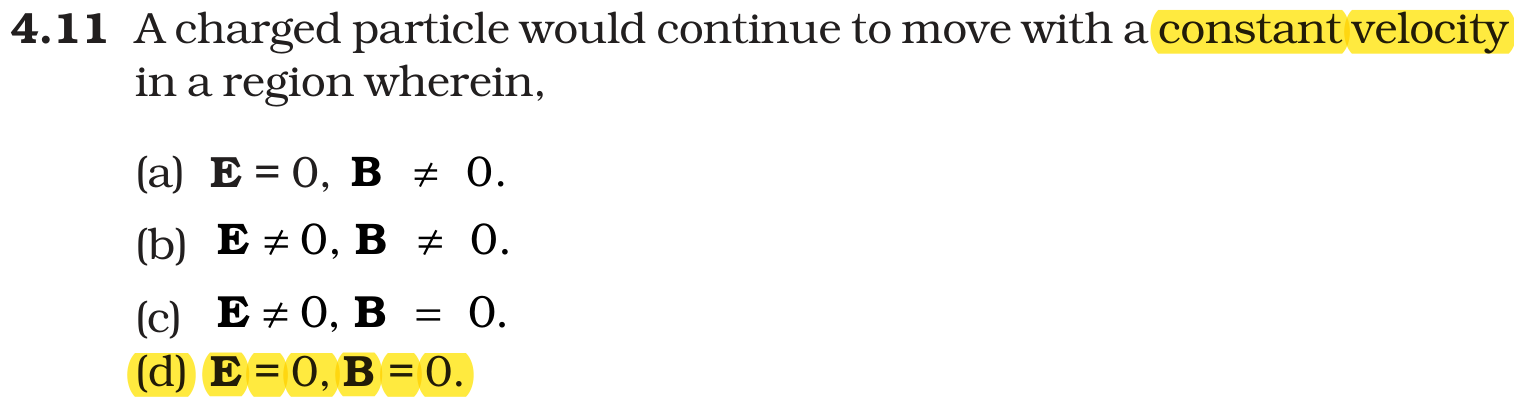
A proton moving with a constant velocity passes through a region without any change in its velocity. Then in this region:
Answer & explanation
Correct answer: option 1
The correct answer is Option (1) → E = 0, B = 0
The velocity of the proton does not change, so the net force on it is zero. In electric and magnetic fields the force is the Lorentz force, \( \vec{F} = q\vec{E} + q(\vec{v}\times\vec{B}) \).
Option (3) \( E\neq0,\ B=0 \) — Incorrect. The force is \( q\vec{E}\neq0 \), which would accelerate the proton.
Option (2) \( E=0,\ B\neq0 \) — the force is \( q(\vec{v}\times\vec{B}) \), which turns the proton in a circle unless \( \vec{B} \) happens to be along \( \vec{v} \).
Option (4) \( E\neq0,\ B\neq0 \) — the velocity stays unchanged only if the two forces exactly cancel, \( \vec{E} = -\vec{v}\times\vec{B} \), as in a velocity selector.
Option (1) \( E=0,\ B=0 \) — Correct. With no field present there is no force at all, so the proton moves with constant velocity whatever its speed or direction.
Note: Options (2) and (4) can also leave the velocity unchanged, but only for special arrangements (the field along the velocity, or crossed fields with \( E=vB \)). Choose the option that holds in every case: with both fields absent, the velocity is unchanged for any direction and any speed.
NCERT Exemplar:
Moving Charges and Magnetism – …