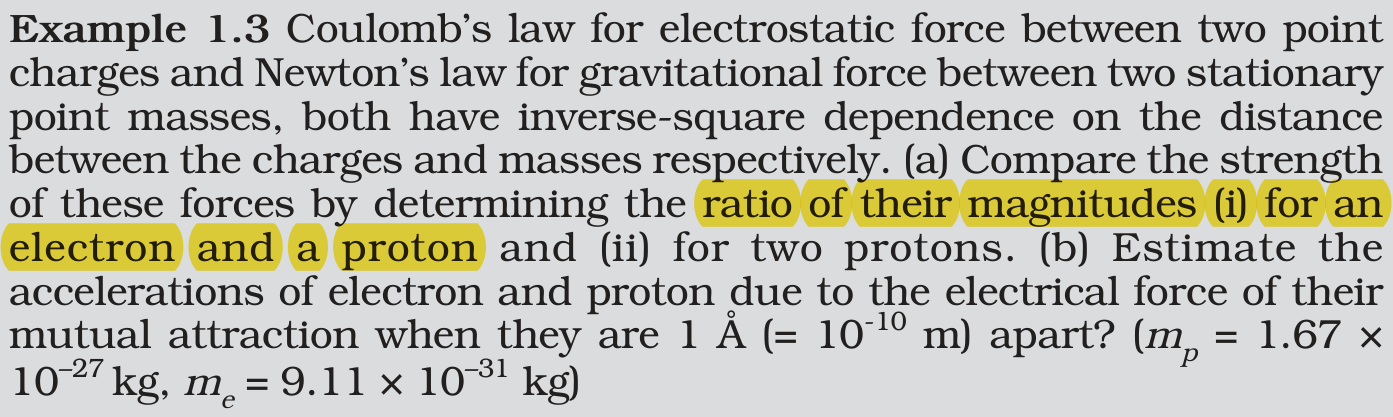
Coulomb’s law for electrostatic force and Newton’s law for gravitational force both have an inverse-square dependence on the distance between the charges and masses, respectively. The ratio of magnitudes of these forces between an electron and a proton will be (Given: \( \varepsilon_{0} = 8.85\times10^{-12}\ \mathrm{N^{-1}\,m^{-2}\,C^{2}} \) and \( G = 6.67\times10^{-11}\ \mathrm{N\,m^{2}\,kg^{-2}} \))
Answer & explanation
Correct answer: option 2
The correct answer is Option (2) → \( 2.4\times10^{39} \)
Both forces follow an inverse-square law, so in their ratio the distance r cancels, and the result is the same at every separation.
\( \displaystyle \frac{F_{e}}{F_{G}} = \frac{\displaystyle\frac{1}{4\pi\varepsilon_{0}}\frac{e^{2}}{r^{2}}}{\displaystyle G\,\frac{m_{e}m_{p}}{r^{2}}} = \frac{e^{2}}{4\pi\varepsilon_{0}\,G\,m_{e}m_{p}} \)
Using \( 1/(4\pi\varepsilon_{0}) \approx 9\times10^{9}\ \mathrm{N\,m^{2}\,C^{-2}} \) (from the given \( \varepsilon_{0} \)) and the standard values \( e = 1.6\times10^{-19}\ \mathrm{C} \), \( m_{e} = 9.1\times10^{-31}\ \mathrm{kg} \), \( m_{p} = 1.67\times10^{-27}\ \mathrm{kg} \):
\( \displaystyle \frac{F_{e}}{F_{G}} = \frac{(9\times10^{9}) \times (1.6\times10^{-19})^{2}}{(6.67\times10^{-11}) \times (9.1\times10^{-31}) \times (1.67\times10^{-27})} \)
\( \displaystyle \frac{F_{e}}{F_{G}} = \frac{2.30\times10^{-28}}{1.01\times10^{-67}} \approx 2.3\times10^{39} \)
This is of the order of \( 2.4\times10^{39} \); the options differ by factors of ten, so only the power of ten decides the answer.
Note: This question is from NCERT (2026-27). NTA sets numerical questions from NCERT too, so do not ignore NCERT while practising numericals.
NCERT (2026-27):
Coulomb’s Law – …