
CUETMOCK
  • Pricing
  • Mentors
Log inStart freeStart free mocks→

First test, then trust

Try a free CUET mock test.

Join 5,00,000+ students who rehearsed exam day on the exact NTA screen before sitting CUET. On the web and on Android.

Start free mocks →Get the Android app
CUETMOCK

India's #1 CUET Mock Test Platform. Original NCERT-based questions on the exact NTA exam screen — trusted by 5,00,000+ students since CUET 2022.

Get it onGoogle PlayScan to download the CUETMOCK app

Mock tests

  • CUET mock test series
  • Browse all papers
  • Commerce mocks
  • Humanities (Arts) mocks
  • Science mocks
  • Languages & GAT mocks
  • Free practice questions
  • Pricing

Resources

  • CUET exam guide
  • CUET syllabus
  • Universities accepting CUET
  • Expert blogs
  • News & notifications
  • Webinars & counselling
  • CUET score calculator
  • How we estimate your rank
  • FAQs

Company

  • About us
  • Our leadership & team
  • Our toppers
  • Mentors
  • For schools
  • Contact us
  • Terms
  • Privacy
  • Refund policy

Talk to us

+91 7696 6630 56info@cuetmock.comWhatsApp us

Our other platforms

  • JEE Mock — For IIT-JEE aspirants
  • NEET Mock — For NEET aspirants

Newsletter

Exam updates, study material and offers — no spam.

© 2026 NYC Ventures Pvt. Ltd.

701-702, Royal Business Park, Zirakpur, Punjab - 140603

  • Terms of use
  • Privacy policy
  • Refund policy
  • Contact us

iCUETMOCK is an independent preparation platform, not affiliated with the National Testing Agency (NTA). Always check exam details on the official NTA website.

  • Home
  • Mock tests
  • CUET guide
  • Pricing
  • Log in
Home/Practice questions/General Aptitude Test
General Aptitude TestNon-Verbal ReasoningDice

Consider the figure:The symbol at the bottom of (D) is

Consider the figure:
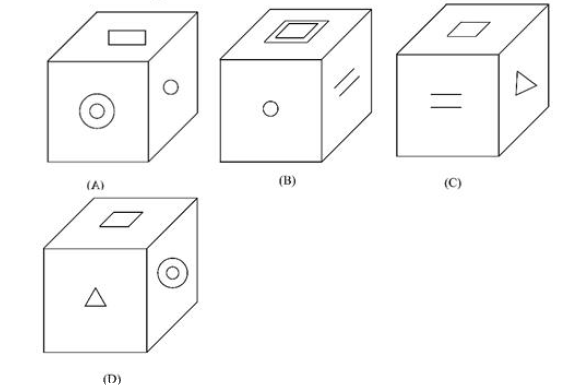
Question figure

The symbol at the bottom of (D) is

Answer & explanation+

Correct answer: option 4

The correct answer is Option (4) → 

Option 4

On a cube, a face can never be next to the face opposite it. So the face opposite a symbol is the one symbol that never appears beside it in any of the positions. The face at the bottom of (D) is the face opposite its top, the small square.

The cube has six symbols: the small square (drawn longer on top of A), the square within a square, the small circle, the double circle, the two parallel lines (slanting on B, level on C) and the triangle.

Faces seen beside the small square (top of A, C and D):

  • Cube (A): the double circle and the small circle

  • Cube (C): the two parallel lines and the triangle

Four of the other five symbols touch the small square, so the fifth, the square within a square (the top of B), is opposite it. It is therefore at the bottom of (D).

Advertisement

Practise more on Non-Verbal Reasoning

Chapter-wise mocks on the real NTA exam screen, with solutions and your rank. Your first mocks are free.

Start free mocks →

Advertisement

Next questions

  1. Who was the founder of Slave dynasty in India?General Aptitude Test · General Knowledge
  2. Select the INCORRECTLY spelt word.English · Spelling Check
  3. The kinetic energy of an electron in the ground state of hydrogen atom is 13.6 eV. The potential energy (P.E) and total energy (E) of elect…Physics · Atoms
  4. If λ is the wavelength of radio signals to be transmitted, then what is the length of Hertz antenna ?Physics · Communication
  5. Identify the refinery at point no 1.Geography · India-People and Economy: Mineral and Energy resources
  6. Which among the following is not present in animal cell?Biology · Cell : The Unit of Life
  7. Who became the Prime Minister of India after Pt. Jawaharlal Nehru?Political Science · Politics in India Since Independence: Challenges to and Restoration of the Congress System
  8. What is the name of Indian Satellite Launch Vehicle?Geography · India-People and Economy: Transport and Communcation
  9. Arrange these forms of marriage in the Manusmriti's order:(A) The voluntary union of a maiden and her lover, which springs from desire(B) T…History · Ancient India: Kinship, Caste and Class
  10. Which of the following statements is true regarding the settlement of the demand of Bodos, Karbis, and Dimasas for a separate state in the…Political Science · Politics in India Since Independence: Regional Aspirations