Suppose the market for cricket balls is perfectly competitive. When the price of a cricket ball is Rs 20, let us assume that 400 cricket balls are supplied by the firms in the market. When the price of a cricket ball rises to Rs 60, let us assume that 2,000 cricket balls are supplied in aggregate by the firms in the market. What will be the value of price elasticity of supply?
Answer & explanation
Correct answer: option 2
The correct answer is Option (2) → 2
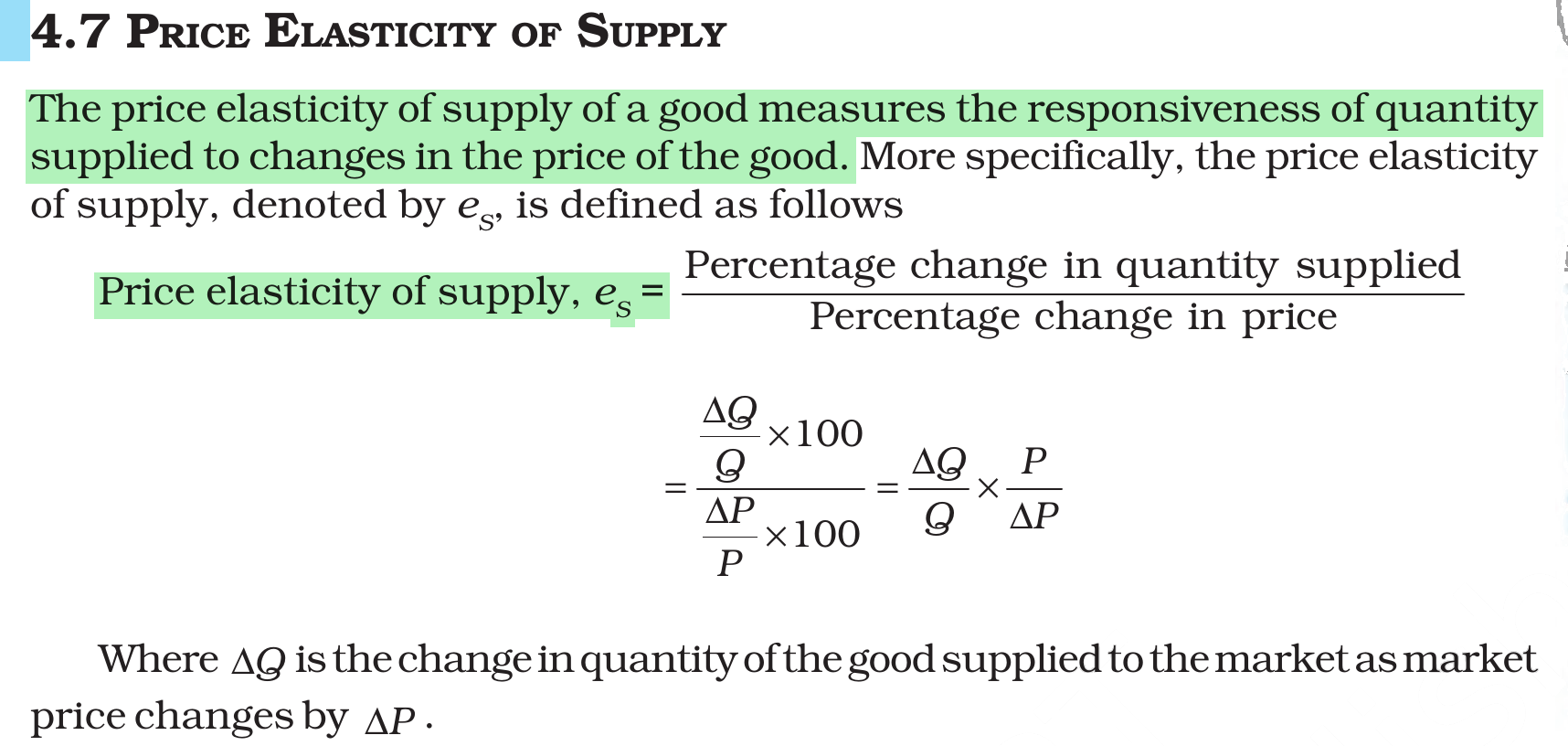
When the price rises, firms offer more for sale; how strongly they respond is measured by the price elasticity of supply, the percentage change in quantity supplied divided by the percentage change in price.
Given:
Initial price, P1 = Rs 20; quantity supplied, Q1 = 400
New price, P2 = Rs 60; quantity supplied, Q2 = 2,000
As a formula:
eS = (ΔQ ÷ Q) ÷ (ΔP ÷ P)
The changes, measured from the initial values:
ΔQ = 2,000 − 400 = 1,600, so ΔQ ÷ Q = 1,600 ÷ 400 = 4, a 400 per cent rise
ΔP = 60 − 20 = 40, so ΔP ÷ P = 40 ÷ 20 = 2, a 200 per cent rise
Substituting:
eS = 4 ÷ 2 = 2, Option (2); since it is greater than 1, supply here is elastic.
NCERT: Introductory Microeconomics — Chapter 4: The Theory of the Firm under Perfect Competition (2025-26)
|