
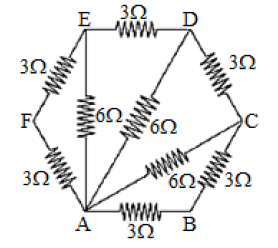
The figure shows a network of resistors. The effective resistance between points A and B of the network is
Answer & explanation
Correct answer: option 4
The correct answer is Option (4) → \( 2\,\Omega \)
From the figure, every side of the hexagon is \( 3\,\Omega \). The three diagonals AE, AD and AC are \( 6\,\Omega \) each. Resistors in series add, and two equal resistors \( R \) in parallel give \( R/2 \). So the network can be reduced one corner at a time, starting at F.
The path A–F–E \( (3\,\Omega+3\,\Omega) \) is in parallel with the diagonal AE:
\( \begin{aligned} R_{AE} &= \frac{(3+3)\times6}{(3+3)+6}\,\Omega \\ &= 3\,\Omega \end{aligned} \)
\( R_{AE} \) plus the side ED is in parallel with the diagonal AD:
\( \begin{aligned} R_{AD} &= \frac{(3+3)\times6}{(3+3)+6}\,\Omega \\ &= 3\,\Omega \end{aligned} \)
\( R_{AD} \) plus the side DC is in parallel with the diagonal AC:
\( \begin{aligned} R_{AC} &= \frac{(3+3)\times6}{(3+3)+6}\,\Omega \\ &= 3\,\Omega \end{aligned} \)
\( R_{AC} \) plus the side CB is in parallel with the side AB:
\( \begin{aligned} R_{AB} &= \frac{(3+3)\times3}{(3+3)+3}\,\Omega \\ &= \frac{18}{9}\,\Omega \\ &= 2\,\Omega \end{aligned} \)