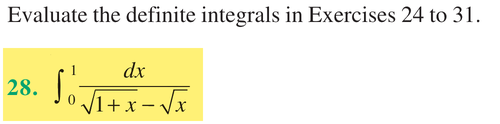
\(\int_{0}^{1}\displaystyle\frac{dx}{\sqrt{1+x}-\sqrt{x}}\) is equal to
Answer & explanation
Correct answer: option 2
The correct answer is Option (2) → \(\displaystyle\frac{4\sqrt{2}}{3}\)
Rationalising the denominator:
\( \displaystyle \frac{1}{\sqrt{1+x}-\sqrt{x}}\cdot\frac{\sqrt{1+x}+\sqrt{x}}{\sqrt{1+x}+\sqrt{x}} = \frac{\sqrt{1+x}+\sqrt{x}}{(1+x) - x} \)
\( \displaystyle = \sqrt{1+x}+\sqrt{x} \)
So
\( \displaystyle I = \int_{0}^{1} \left(\sqrt{1+x}+\sqrt{x}\right)dx \)
\( \displaystyle = \left[\frac{2}{3}(1+x)^{3/2} + \frac{2}{3}x^{3/2}\right]_{0}^{1} \)
\( \displaystyle = \frac{2}{3}\left(2\sqrt{2} + 1\right) - \frac{2}{3}(1 + 0) \)
\( \displaystyle = \frac{4\sqrt{2}}{3} \)
NCERT (2026-27 edition):
Integrals