
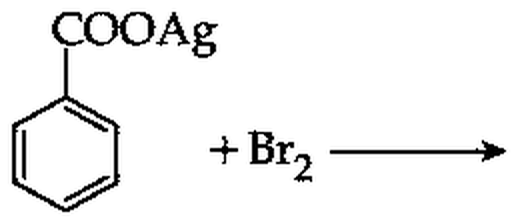
Predict the product for the reaction :
Answer & explanation
Correct answer: option 2
The correct answer is Option (2) → bromobenzene
When the silver salt of a carboxylic acid is heated with bromine (usually in \( \ce{CCl4} \)), the carboxyl group is lost as \( \ce{CO2} \) and replaced by a bromine atom. This is the Hunsdiecker reaction, a decarboxylative bromination: the product has one carbon atom fewer than the acid.
\( \displaystyle \ce{RCOOAg + Br2} \xrightarrow{\ce{CCl4},\ \text{heat}} \ce{RBr + CO2 ^ + AgBr v} \)
For silver benzoate:
\( \displaystyle \ce{C6H5COOAg + Br2} \xrightarrow{\ce{CCl4},\ \text{heat}} \ce{C6H5Br + CO2 ^ + AgBr v} \)
So the product is bromobenzene.
Why the other options are incorrect
Option (1) benzoyl hypobromite (C6H5COOBr) — Incorrect. This acyl hypobromite is only the short-lived intermediate of the reaction; it breaks down at once, losing \( \ce{CO2} \).
Option (3) 3-bromobenzoic acid — Incorrect. This would need electrophilic substitution in the ring (\( \ce{Br2} \) with \( \ce{FeBr3} \), −COOH directing meta); here the carboxyl group itself is removed.
Option (4) 4-bromobenzoic acid — Incorrect. The −COOH group is a meta director, so para bromination of the ring is not expected, and in any case the carboxyl group does not survive the reaction.
Note: The question is from beyond the NCERT textbook.