
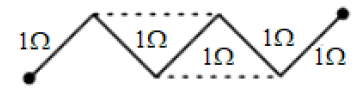
A circuit consists of five identical conductors, each of resistance \( 1\,\Omega \), as shown in the figure. Two similar conductors are then added as indicated by the dotted lines. The ratio of the resistances (between the end points) before and after the addition is
Answer & explanation
Correct answer: option 3
The correct answer is Option (3) → \( 5/3 \)
Before the addition the five conductors are joined end to end, so they are in series. After the addition the middle part of the circuit forms a Wheatstone bridge. A bridge is balanced when the resistances of its arms are in the same ratio on both sides. Then no current flows through the conductor in the middle.
Before the addition the resistance is:
\( \begin{aligned} R_{\mathrm{before}} &= (1+1+1+1+1)\,\Omega \\ &= 5\,\Omega \end{aligned} \)
Label the left end A and the right end B. Call the upper corners P and R, and the lower corners Q and S. The zigzag then runs A–P–Q–R–S–B. From the figure, the dotted conductors join P to R and Q to S. Between P and S the conductors then form a bridge:
P–Q and Q–S, one path through Q
P–R and R–S, the other path through R
Q–R, the middle conductor joining the two paths
Every arm is \( 1\,\Omega \), so the ratios P–Q : Q–S and P–R : R–S are both 1 : 1. So the bridge is balanced. Q and R are at the same potential, and no current flows through Q–R. The two paths of \( 2\,\Omega \) each are then in parallel:
\( \begin{aligned} R_{\mathrm{PS}} &= \frac{2\times2}{2+2}\,\Omega \\ &= 1\,\Omega \end{aligned} \)
The conductors A–P and S–B are in series with this part:
\( \begin{aligned} R_{\mathrm{after}} &= (1+1+1)\,\Omega \\ &= 3\,\Omega \end{aligned} \)
The ratio of the two resistances is:
\( \begin{aligned} \frac{R_{\mathrm{before}}}{R_{\mathrm{after}}} &= \frac{5\,\Omega}{3\,\Omega} \\ &= \frac{5}{3} \end{aligned} \)
NCERT (2026-27):
Wheatstone Bridge – “… Of special interest, is the case of a balanced bridge where the resistors are such that Ig = 0. …”
Wheatstone Bridge – “… Hence, we obtain the condition
\( \displaystyle \frac{R_2}{R_1}=\frac{R_4}{R_3} \)\( \qquad [3.64(a)] \)
This last equation relating the four resistors is called the balance condition for the galvanometer to give zero or null deflection.”