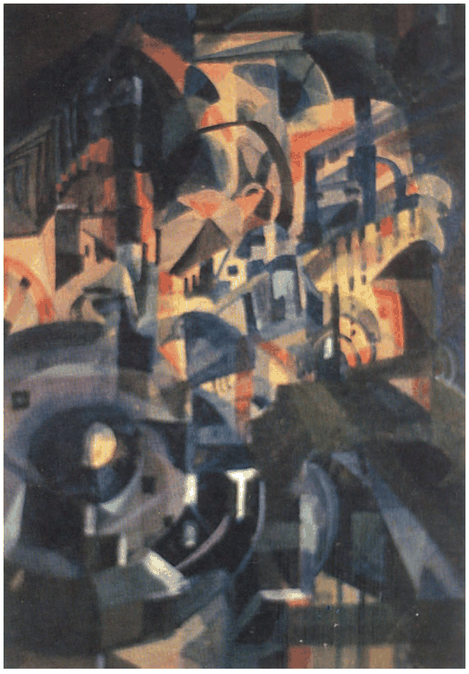
The statements below are about Gaganendranath Tagore’s painting City in the Night. Given below are two statements: one is labelled as Assertion (A) and the other is labelled as Reason (R).
Assertion (A): The painter visualised imaginary cities like Dwarka and Swarnapuri through multiple viewpoints, multi-faceted shapes and jagged edges.
Reason (R): The painter was one of the earlier Indian painters who made use of the language and syntax of Cubism to render his ideas.
In the light of the above statements, choose the most appropriate answer from the options given below:
Answer & explanation
Correct answer: option 1
The correct answer is Option (1) → Both (A) and (R) are true and (R) is the correct explanation of (A).
Assertion (A): The painter visualised imaginary cities like Dwarka and Swarnapuri through multiple viewpoints, multi-faceted shapes and jagged edges. — True. Dwarka is Lord Krishna’s legendary abode and Swarnapuri is the Golden City. He showed them through multiple viewpoints, multi-faceted shapes and jagged edges.
Reason (R): The painter was one of the earlier Indian painters who made use of the language and syntax of Cubism to render his ideas. — True. He used Cubism to render his ideas.
Why R explains A? Multi-faceted shapes and jagged edges belong to the language of Cubism. Because Gaganendranath worked in this language, he showed his imaginary cities in these Cubist forms.
NCERT (2026-27): “City in the Night This is a watercolour painting made by Gaganendranath Tagore (1869 –1938) in 1922. He was one of the earlier Indian painters, who made use of language and syntax of Cubism to render his ideas. …He visualised the mysterious world of his imaginary cities like Dwarka (Lord Krishna’s legendary abode) or Swarnapuri (The Golden City) through multiple viewpoints, multi-faceted shapes and jagged edges of Cubism.”
|