
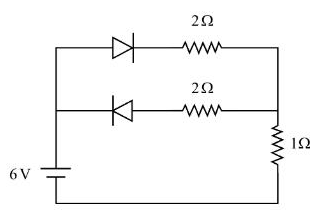
The current flowing through \( 1\,\Omega \) resistor in the given circuit is:
Answer & explanation
Correct answer: option 3
The correct answer is Option (3) → \( 2.0\,\mathrm{A} \)
A p-n junction diode conducts when forward biased and blocks the current when reverse biased; the diodes are taken as ideal (zero resistance when conducting). The positive terminal of the 6 V battery is at the top, and conventional current leaves it and flows through the circuit in the direction of the diode arrows.
The upper diode has its arrow pointing along the current, so it is forward biased and conducts. The lower diode has its arrow pointing against the current, so it is reverse biased and no current flows in that branch.
The circuit therefore reduces to the battery with the upper 2 Ω resistor and the 1 Ω resistor in series.
\( R_{\mathrm{total}} = 2\,\Omega + 1\,\Omega = 3\,\Omega \)
\( \displaystyle I = \frac{V}{R_{\mathrm{total}}} = \frac{6\,\mathrm{V}}{3\,\Omega} = 2.0\,\mathrm{A} \)
The same current flows through the 1 Ω resistor.