
Arrange the following in the increasing order of their boiling points
(A) \( n-C_4H_9NH_2 \)
(B) \( (C_2H_5)_2NH \)
(C) \( n-C_4H_9OH \)
(D) \( C_2H_5N(CH_3)_2 \)
Choose the correct answer from the options given below:
Answer & explanation
Correct answer: option 4
The correct answer is Option (4) → (D), (B), (A), (C)
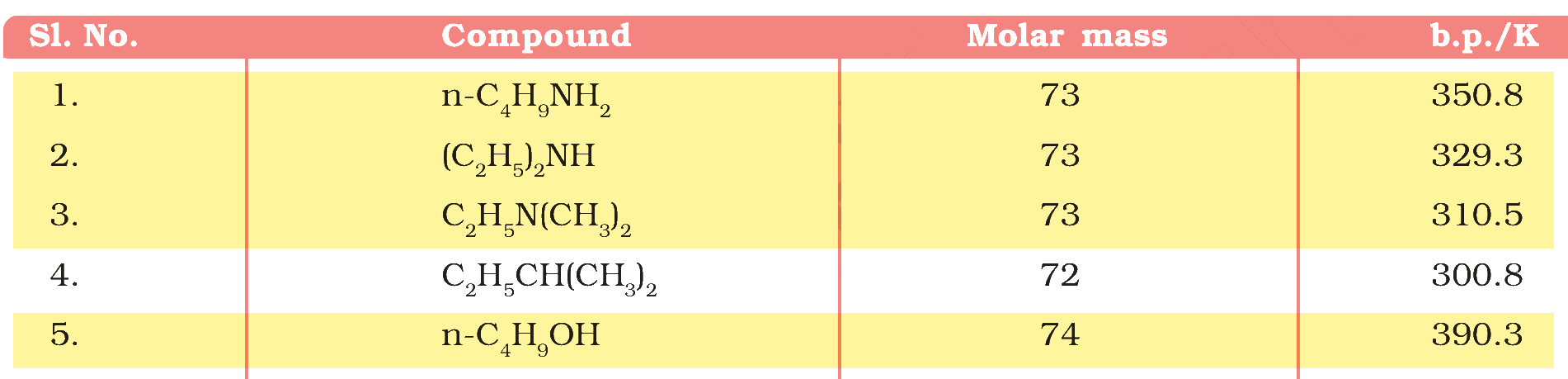
The four compounds have almost the same molar mass (73 to 74 g mol−1), so their boiling points are decided by intermolecular hydrogen bonding. Three points settle the order:
An O–H bond is more polar than an N–H bond, so alcohols form stronger hydrogen bonds than amines.
A primary amine has two N–H hydrogens and a secondary amine only one, so hydrogen bonding is more extensive in primary amines.
A tertiary amine has no hydrogen on nitrogen and cannot form hydrogen bonds between its own molecules.
\( \displaystyle \text{tertiary amine} \lt \text{secondary amine} \lt \text{primary amine} \lt \text{alcohol} \)
Matching the labels:
(D) \( \ce{C2H5N(CH3)2} \): N,N-dimethylethanamine (tertiary amine)
(B) \( \ce{(C2H5)2NH} \): N-ethylethanamine (secondary amine)
(A) \( \ce{CH3(CH2)3NH2} \): butan-1-amine (primary amine)
(C) \( \ce{CH3(CH2)3OH} \): butan-1-ol (alcohol)
Shortcut: The tertiary amine (D) has the lowest and the alcohol (C) the highest boiling point. Only Option (4) starts with (D) and ends with (C).
NCERT (2026-27 edition):
Physical Properties – …
Note: The same/similar question has been asked in different years by NTA as per the details given below:
| 2026 | 2025 | 2024 | 2023 | 2022 |
|---|---|---|---|---|
| – | 28-05 S1 | – | – | 17-08 S1 |