If due to fall in price, total expenditure on the commodity falls, it indicates?
Answer & explanation
Correct answer: option 2
The correct answer is Option (2) → price elasticity of demand is less than unity.
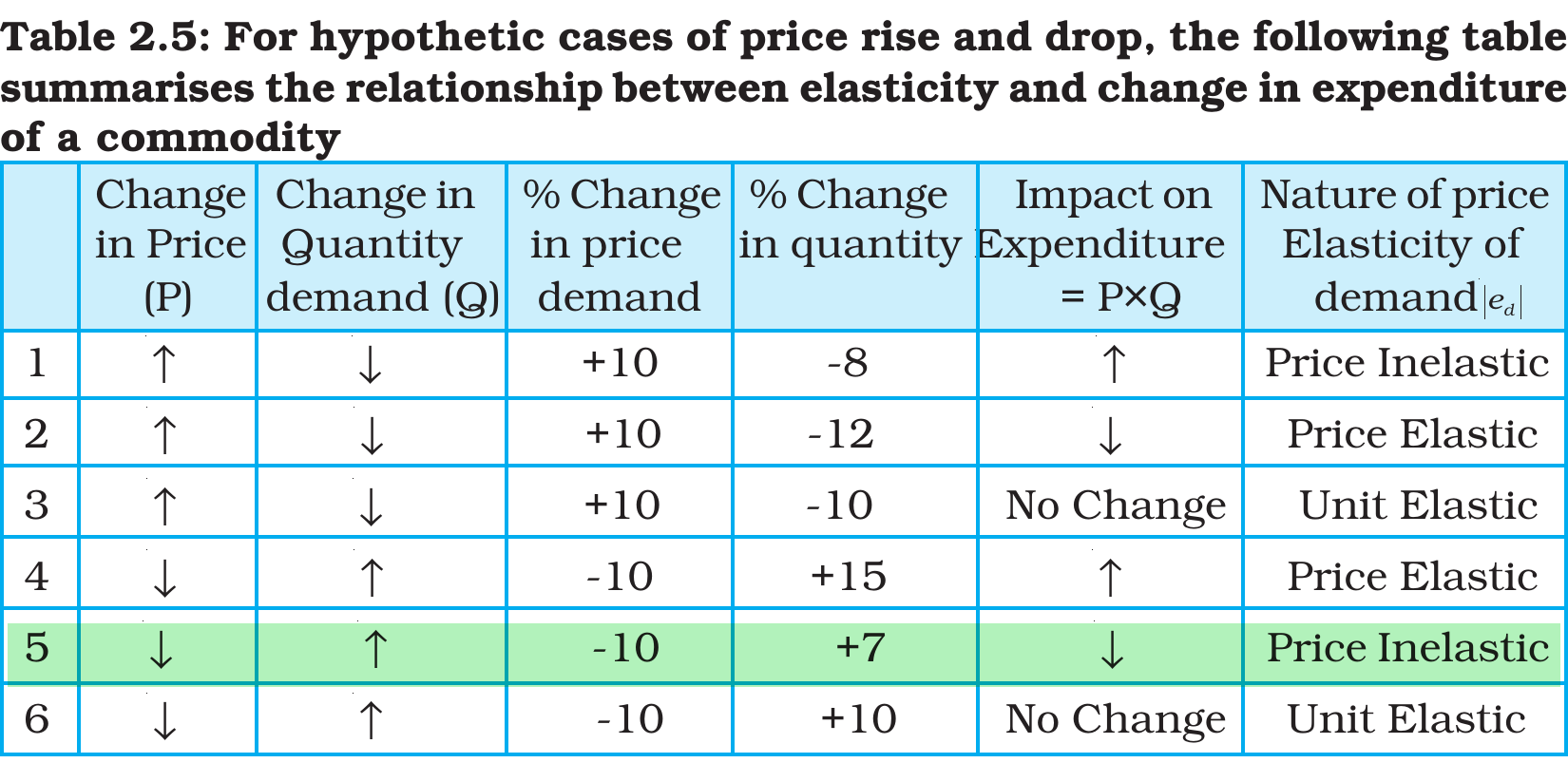
Total expenditure on a good is price multiplied by quantity (P × Q). A fall in price can raise the quantity bought. Expenditure falls only if the rise in quantity is proportionately smaller than the fall in price, and then demand is inelastic. For example, price falls by 10 per cent, quantity rises by 7 per cent, and expenditure falls.
Option (1) price elasticity of demand is zero. — Incorrect. Zero elasticity means that quantity does not change at all when price changes. Expenditure would fall then too, but a fall in expenditure shows only that elasticity is below one, not that it is zero.
Option (2) price elasticity of demand is less than unity. — Correct. Quantity rises by a smaller percentage than price falls, so P × Q falls.
Option (3) price elasticity of demand is infinity. — Incorrect. Infinite elasticity belongs to a horizontal demand curve. Even a small fall in price would raise quantity very greatly, so expenditure would not fall.
Option (4) price elasticity of demand is greater than unity. — Incorrect. Quantity would rise by a larger percentage than price falls. So expenditure would rise. For example, price falls by 10 per cent and quantity rises by 15 per cent.
NCERT (2026-27): “2.6.3 Elasticity and Expenditure The expenditure on a good is equal to the demand for the good times its price. Often it is important to know how the expenditure on a good changes as a result of a price change.… …Now consider a decline in the price of the good. If the percentage increase in quantity is greater than the percentage decline in the price, the expenditure on the good will go up(see row 4 in table 2.5). On the other hand, if the percentage increase in quantity is less than the percentage decline in the price, the expenditure on the good will go down(see row 5 in table 2.5). And if the percentage increase in quantity is equal to the percentage decline in the price, the expenditure on the good will remain unchanged (see row 6 in table 2.5). The expenditure on the good would change in the same direction as the price change if and only if the percentage change in quantity is less than the percentage change in price, i.e., if the good is price inelastic (see rows 1 and 5 in table 2.5).… …When the percentage change in quantity demanded is less than the percentage change in market price, eD is estimated to be less than one and the demand for the good is said to be inelastic at that price.…”
|