
What is the final step after gel electrophoresis to obtain purified DNA fragments?
Answer & explanation
Correct answer: option 3
The correct answer is Option (3) → Cutting out DNA bands from the gel
Gel electrophoresis separates DNA fragments by size. The fragments move through an agarose gel towards the anode, and the smaller ones move farther. The fragments cannot be seen in plain light, so the gel is stained and viewed first. Only then can the wanted bands be cut out and the DNA taken out of them.
Option (1) Exposure to UV radiation — Incorrect. UV light is used only to see the stained DNA bands. It comes before the bands are cut, and it does not purify any DNA.
Option (2) Addition of ethidium bromide — Incorrect. Ethidium bromide is a stain. It makes the DNA bands glow bright orange under UV light. Staining is an early step that lets us locate the bands, not the final step.
Option (3) Cutting out DNA bands from the gel — Correct. The separated bands are cut out of the agarose gel and the DNA is extracted from each gel piece. This last step is called elution. The DNA purified this way is then joined with cloning vectors to make recombinant DNA.
NCERT Extract:
Separation and Isolation of DNA Fragments – “… The separated DNA fragments can be visualised only after staining the DNA with a compound known as ethidium bromide followed by exposure to UV radiation (you cannot see pure DNA fragments in the visible light and without staining). You can see bright orange coloured bands of DNA in a ethidium bromide stained gel exposed to UV light (Figure 9.3). The separated bands of DNA are cut out from the agarose gel and extracted from the gel piece. This step is known as elution. The DNA fragments purified in this way are used in constructing recombinant DNA by joining them with cloning vectors.”
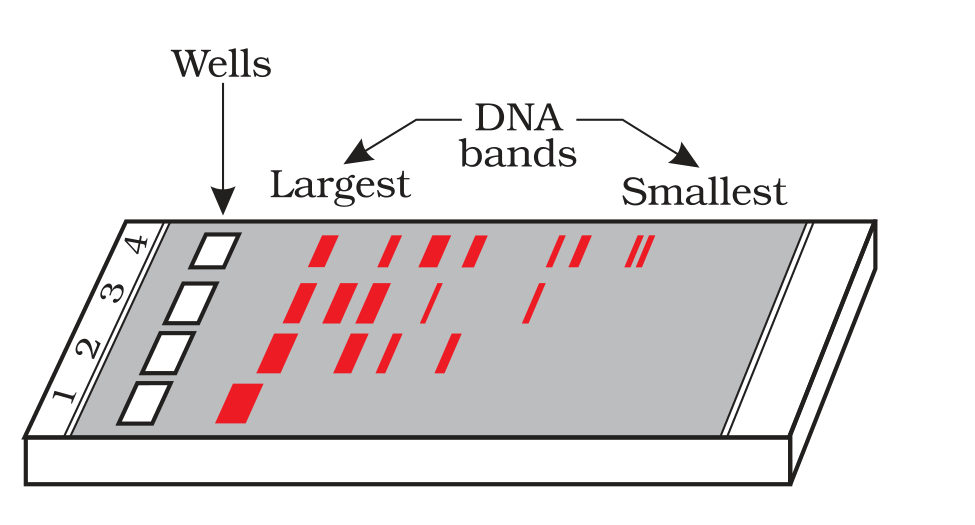
Figure 9.3 A typical agarose gel electrophoresis showing migration of undigested (lane 1) and digested set of DNA fragments (lane 2 to 4)