CUETMOCK
  • Pricing
  • Mentors
Log inStart freeStart free mocks→

First test, then trust

Try a free CUET mock test.

Join 5,00,000+ students who rehearsed exam day on the exact NTA screen before sitting CUET. On the web and on Android.

Start free mocks →Get the Android app
CUETMOCK

India's #1 CUET Mock Test Platform. Original NCERT-based questions on the exact NTA exam screen — trusted by 5,00,000+ students since CUET 2022.

Get it onGoogle PlayScan to download the CUETMOCK app

Mock tests

  • CUET mock test series
  • Browse all papers
  • Commerce mocks
  • Humanities (Arts) mocks
  • Science mocks
  • Languages & GAT mocks
  • Free practice questions
  • Pricing

Resources

  • CUET exam guide
  • CUET syllabus
  • Universities accepting CUET
  • Expert blogs
  • News & notifications
  • Webinars & counselling
  • CUET score calculator
  • How we estimate your rank
  • FAQs

Company

  • About us
  • Our leadership & team
  • Our toppers
  • Mentors
  • For schools
  • Contact us
  • Terms
  • Privacy
  • Refund policy

Talk to us

+91 7696 6630 56info@cuetmock.comWhatsApp us

Our other platforms

  • JEE Mock — For IIT-JEE aspirants
  • NEET Mock — For NEET aspirants

Newsletter

Exam updates, study material and offers — no spam.

© 2026 NYC Ventures Pvt. Ltd.

701-702, Royal Business Park, Zirakpur, Punjab - 140603

  • Terms of use
  • Privacy policy
  • Refund policy
  • Contact us

iCUETMOCK is an independent preparation platform, not affiliated with the National Testing Agency (NTA). Always check exam details on the official NTA website.

  • Home
  • Mock tests
  • CUET guide
  • Pricing
  • Log in
Home/Practice questions/Accountancy Part A
Accountancy Part AAccounting for Shares

Read the following facts about shares and debentures. (A) Both shares…

Read the following facts about shares and debentures.

(A) Both shares and debentures can be issued by a company for raising long term funds.

(B) Both shares and debentures can be issued for consideration other than cash.

(C) Both shares and debentures can be issued at premium

(D) Debentures can be converted into shares and shares can be converted into debentures

(E) Dividend is paid on shares and debentures both

Choose the correct answer from the options given below :

Answer & explanation+

Correct answer: option 1

The correct answer is Option (1) → (A), (B) and (C) Only

(A) Both shares and debentures can be issued by a company for raising long term funds. — True. Shares give owned capital and debentures borrowed capital, both for long periods.

(B) Both shares and debentures can be issued for consideration other than cash. — True. Either can be given to vendors in payment for assets bought.

(C) Both shares and debentures can be issued at premium — True. Either can be issued for more than its face value.

(D) Debentures can be converted into shares and shares can be converted into debentures — False. Only debentures can be converted into shares; shares cannot be converted into debentures.

(E) Dividend is paid on shares and debentures both — False. Shareholders get dividend, but debentureholders get interest.

NCERT (2026-27 edition):
Cash from Financing Activities – “As the name suggests, financing activities relate to long-term funds or capital of an enterprise, e.g., cash proceeds from issue of equity shares, debentures, raising long-term bank loans, repayment of bank loan, etc.”

NCERT (2026-27 edition):
Issue of Shares for Consideration other than Cash – “There are instances where a company enters into an arrangement with the vendors from whom it has purchased assets, whereby the latter agrees to accept, the payment in the form of fully paid shares of the company issued to them. Normally, no such cash is received for issue of shares. These shares can also be issued either at par, at premium or at discount, and the number of shares to be issued will depend upon the price at which the shares are issued and the amount payable to the vendor.”

NCERT (2026-27 edition):
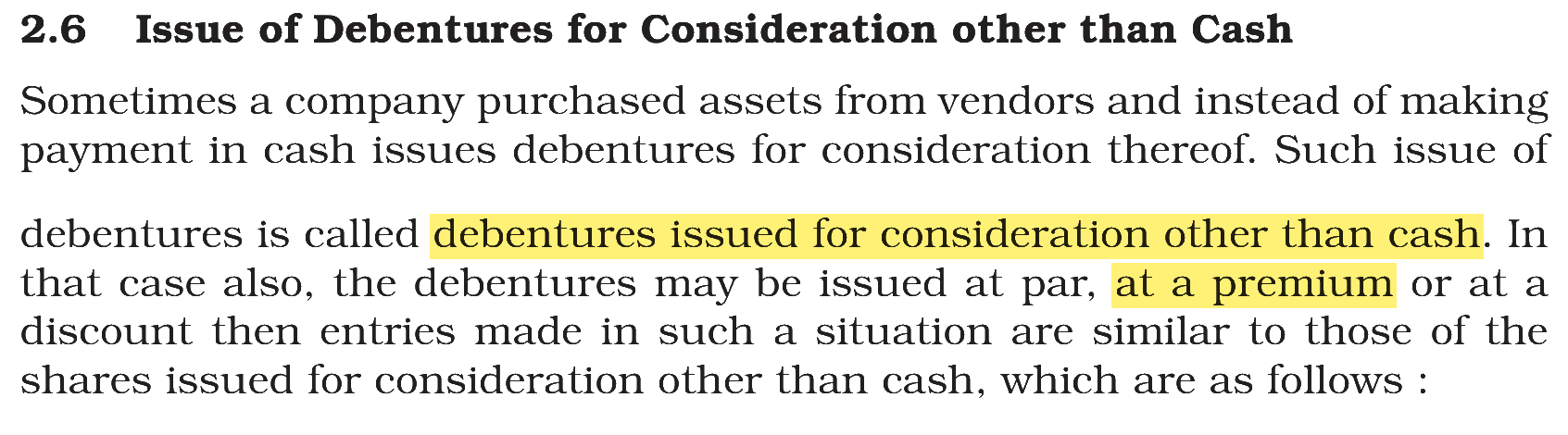
Issue of Debentures for Consideration other than Cash

Extract from the NCERT textbook

NCERT (2026-27 edition):
Return – “… The return on shares is known as dividend while the return on debentures is called interest.”

NCERT (2026-27 edition):
Convertibility – “… Shares cannot be converted into debentures whereas debentures can be converted into shares if the terms of issue so provide, and in that case these are known as convertible debentures.”

Advertisement

Practise more on Accounting for Shares

Chapter-wise mocks on the real NTA exam screen, with solutions and your rank. Your first mocks are free.

Start free mocks →

Advertisement

Next questions

  1. In the 1840s, a disease destroyed the potato crop and about a million people died of starvation in which country?General Aptitude Test · General Knowledge
  2. Major characteristics of hunting and gathering are: (A) It often involves primitive societies, who depend on plants and animals to satisfy…Geography · Fundamentals of Human Geography: Primary Activities
  3. The Akbarnama, the official history of Akbar’s reign, was written by which of his courtiers?General Aptitude Test · General Knowledge
  4. Suvidha Ltd. purchased machinery worth Rs.1,98,000 from Suppliers Ltd. The payment was made by issue of 12% debentures of Rs.100 each. How…Accountancy Part A · Issue and Redemption of Debentures
  5. An electron (mass m) with an initial velocity v=v_0hat i is in an electric field E=E_0hat j. If λ_0h/mv_0, its de- Broglie wavelength at ti…Physics · Dual Nature of Radiation and Matter
  6. The energy stored in an inductor does not depend on which of the following?Physics · Electromagnetic Induction
  7. In a certain code language, 'GBTMS' is written as 'HNGYT' and 'PONDEK' is written as 'PVWMLK'. How will 'VIGOUR' be written in that code la…General Aptitude Test · Verbal Reasoning
  8. Find the largest 4 digit number that is exactly divisible by 66.General Aptitude Test · Numerical Ability
  9. In a second-order reaction, if first-order is observed for both the reactants A and B, then which one of the following reactant mixtures wi…Chemistry · Physical: Chemical Kinetics
  10. Identify the step in the process of organising that requires grouping of activities which are similar in nature together.Business Studies · Organising