Which of the two monosaccharide units are bonded by glycosidic linkage in sucrose disaccharide?
Answer & explanation
Correct answer: option 3
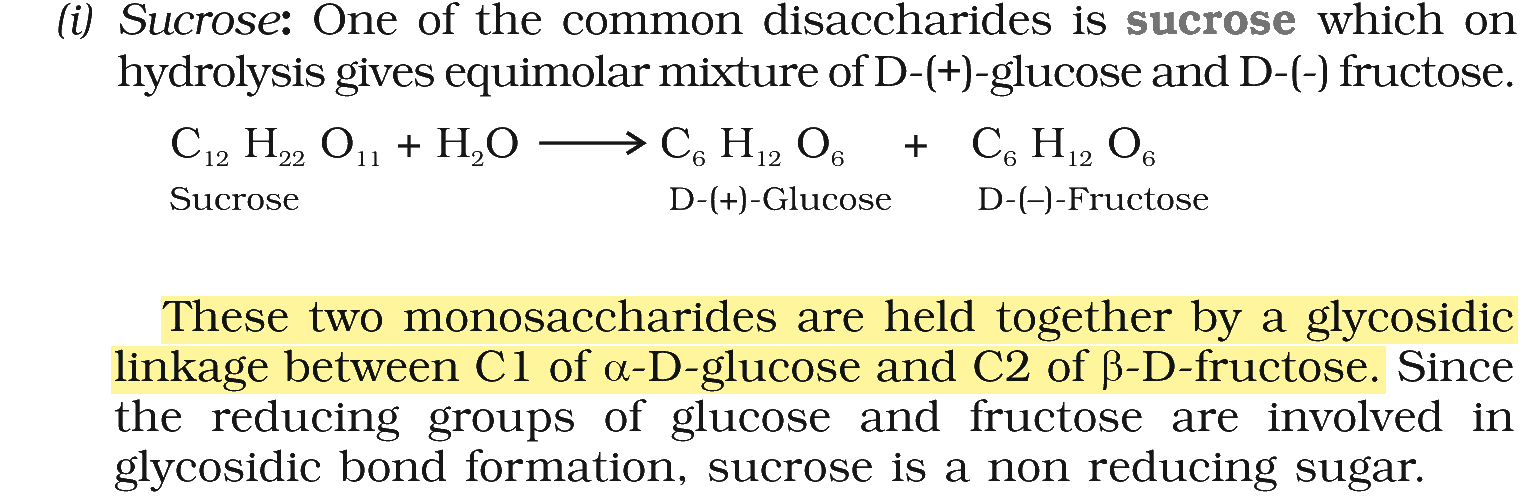
The correct answer is Option (3) → α-D-Glucose +β-D-Fructose
A disaccharide is made of two monosaccharide units joined by a glycosidic linkage, an oxygen bridge formed with the loss of a water molecule. The three common disaccharides are:
Sucrose: α-D-glucose and β-D-fructose, joined between C-1 of glucose and C-2 of fructose. Both reducing groups are used up in this bond, so sucrose is a non-reducing sugar.
Maltose: two α-D-glucose units, joined between C-1 and C-4. It is a reducing sugar.
Lactose (milk sugar): β-D-galactose and β-D-glucose, joined between C-1 of galactose and C-4 of glucose. It is a reducing sugar.
So sucrose is formed from α-D-glucose and β-D-fructose.
Why the other options are incorrect
Option (1) α-D-Glucose + α-D-Glucose — Incorrect. Two α-D-glucose units make up maltose.
Option (2) β-D-Fructose + β-D- Glucose — Incorrect. Fructose in sucrose is the β-form, but glucose is the α-form, not the β-form.
Option (4) β-D-Galactose + β-D- Glucose — Incorrect. β-D-Galactose and β-D-glucose make up lactose.
NCERT (2026-27 edition):
Sucrose