
In the following figure which of the diodes is forward biased.
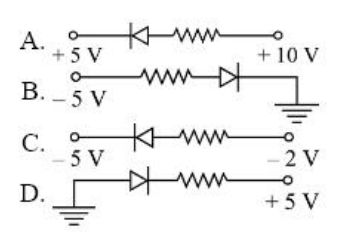
Choose the correct answer from the options given below:
Answer & explanation
Correct answer: option 3
The correct answer is Option (3) → A and C only
A p-n junction diode is forward biased when its p-side (the anode, the flat side of the triangle) is at a higher potential than its n-side (the cathode, the bar side). So for each circuit compare the potentials at the two ends of the diode branch; the resistor only limits the current and does not change which way the diode is biased.
A: anode at \( +10\,\mathrm{V} \), cathode at \( +5\,\mathrm{V} \) — anode is higher, forward.
B: anode at \( -5\,\mathrm{V} \), cathode earthed (\( 0\,\mathrm{V} \)) — anode is lower, reverse.
C: anode at \( -2\,\mathrm{V} \), cathode at \( -5\,\mathrm{V} \) — anode is higher, forward.
D: anode earthed (\( 0\,\mathrm{V} \)), cathode at \( +5\,\mathrm{V} \) — anode is lower, reverse.
NCERT (2026-27):
p-n Junction Diode Under Forward Bias – “When an external voltage V is applied across a semiconductor diode such that p-side is connected to the positive terminal of the battery and n-side to the negative terminal [Fig. 14.13(a)], it is said to be forward biased.”
p-n Junction Diode Under Reverse Bias – “When an external voltage (V) is applied across the diode such that n-side is positive and p-side is negative, it is said to be reverse biased [Fig.14.15(a)].”