
Assertion (A): Only the functional megaspore undergoes three mitotic divisions to form a mature embryo sac.
Reason (R): Three of the four megaspores produced during meiosis degenerate, leaving one megaspore to develop into the embryo sac.
Answer & explanation
Correct answer: option 1
The correct answer is Option (1) → Both A and R are true, and R is the correct explanation of A.
Assertion (A): Only the functional megaspore undergoes three mitotic divisions to form a mature embryo sac. — True. The megaspore mother cell divides by meiosis to give four megaspores. Only one of them, the functional megaspore, forms the embryo sac. Its nucleus divides mitotically three times (giving 2, then 4, then 8 nuclei), and the mature 7-celled, 8-nucleate embryo sac is formed.
Reason (R): Three of the four megaspores produced during meiosis degenerate, leaving one megaspore to develop into the embryo sac. — True. In most flowering plants, three of the four megaspores degenerate. Only one is left to develop into the embryo sac. This is called monosporic development.
Why R explains A? A is about why only one megaspore goes on to divide and form the embryo sac. R gives the cause: the other three megaspores degenerate, so only one megaspore is left. That is why the three mitotic divisions happen in the functional megaspore alone. So both statements are correct, and R is the correct explanation of A.
NCERT Extract:
The Pistil, Megasporangium (Ovule) and Embryo Sac – “… Meiosis results in the production of four megaspores (Figure 1.8a). Female gametophyte : In a majority of flowering plants, one of the megaspores is functional while the other three degenerate. Only the functional megaspore develops into the female gametophyte (embryo sac). This method of embryo sac formation from a single megaspore is termed monosporic development.”
The Pistil, Megasporangium (Ovule) and Embryo Sac – “… The nucleus of the functional megaspore divides mitotically to form two nuclei which move to the opposite poles, forming the 2-nucleate embryo sac. Two more sequential mitotic nuclear divisions result in the formation of the 4-nucleate and later the 8-nucleate stages of the embryo sac.”
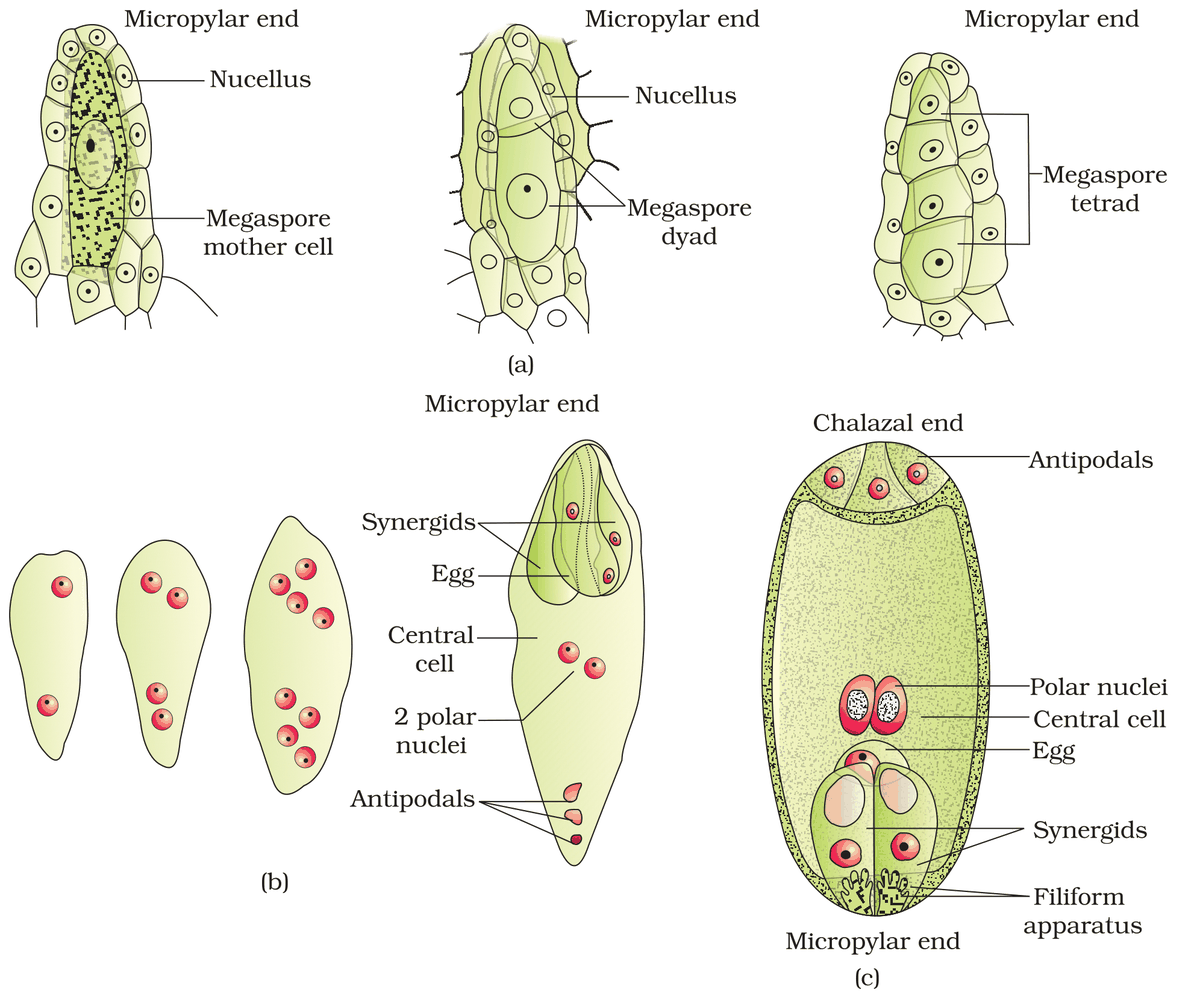
Figure 1.8 (a) Parts of the ovule showing a large megaspore mother cell, a dyad and a tetrad of megaspores; (b) 2, 4, and 8-nucleate stages of embryo sac and a mature embryo sac; (c) A diagrammatic representation of the mature embryo sac