The reason for the indifference curve being convex to origin is :
Answer & explanation
Correct answer: option 3
The correct answer is Option (3) → diminishing marginal rate of substitution
An indifference curve shows combinations of two goods that give the same satisfaction. Its shape comes from how much of one good the consumer gives up for one more unit of the other. That amount is the marginal rate of substitution (MRS).
Option (1) marginal utility — Incorrect. This is the extra satisfaction from one more unit of a good. It is a measure of satisfaction, and alone it does not give the curve its shape.
Option (2) complementary goods — Incorrect. These are goods consumed together, such as tea and sugar. That is a relation between goods, and it does not explain the convex shape.
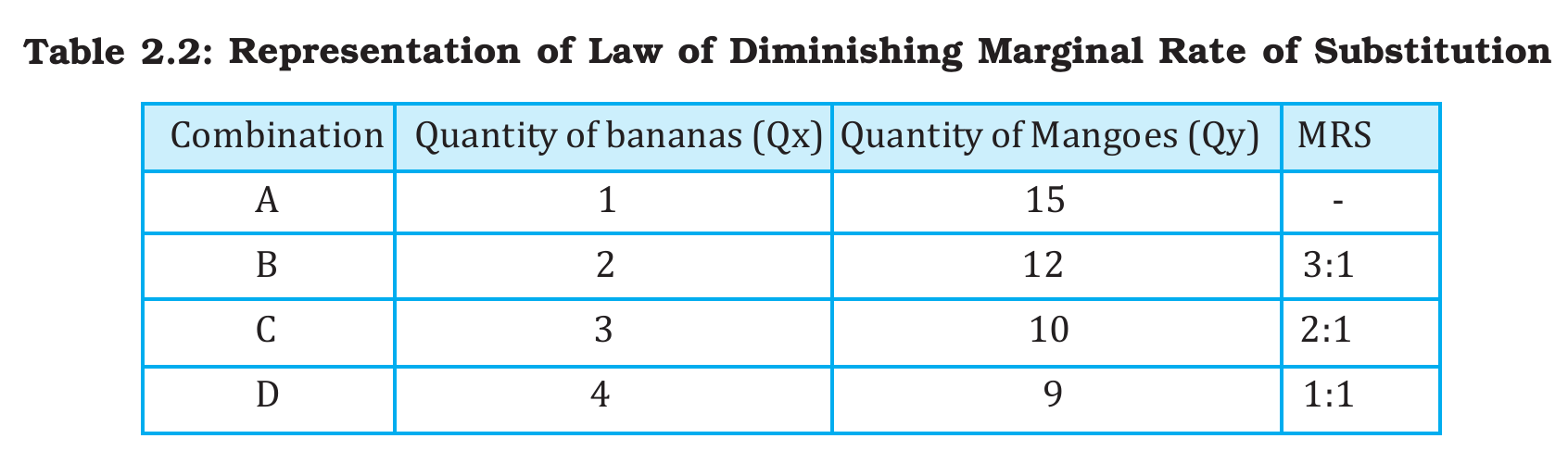
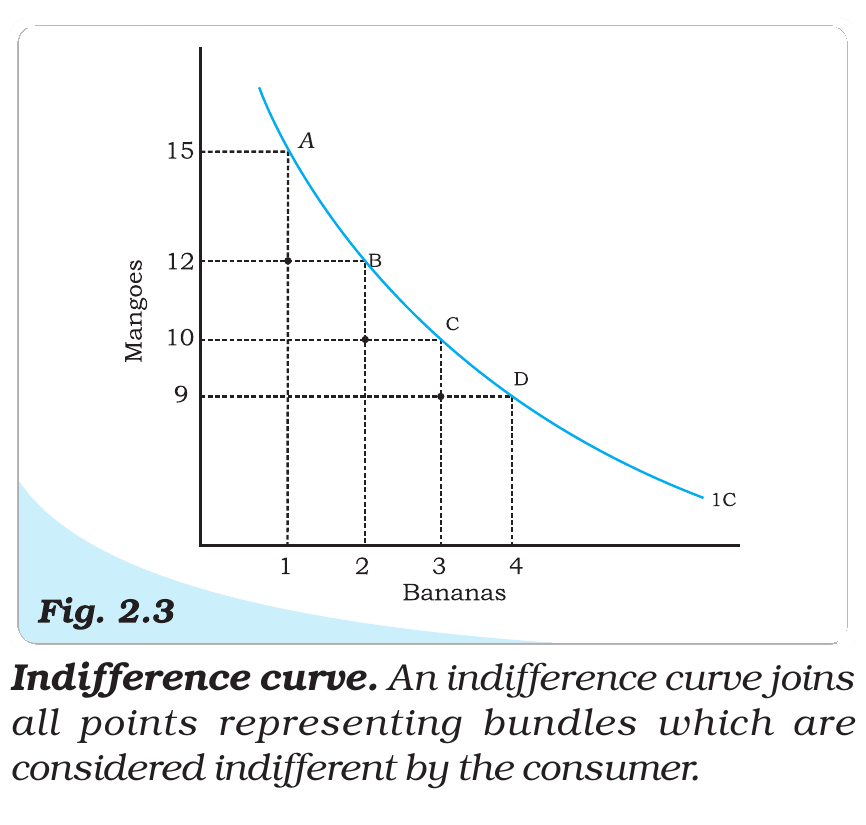
Option (3) diminishing marginal rate of substitution — Correct. For example, as a consumer gets more bananas, she gives up fewer and fewer mangoes for each extra banana. The curve gets flatter as it moves right, so it is convex to the origin.
Option (4) diminishing marginal utility — Incorrect. Falling extra satisfaction helps explain why the MRS falls. The law that directly gives the curve its shape is the law of diminishing MRS.
Note: A same/similar question was asked in CUET (UG) in the papers below.
| 2026 | 2025 | 2024 | 2023 | 2022 |
| 15-05 S1* | 14-05 S1* | – | 13-06 S1 | – |
* A similar question.
NCERT (2026-27): “2.1.2 Ordinal Utility Analysis …The amount of mangoes that the consumer has to forego, in order to get an additional banana, her total utility level being the same, is called marginal rate of substitution (MRS).… One can notice that, in the table 2.2, as we increase the quantity of bananas, the quantity of mangoes sacrificed for each additional banana declines. In other words, MRS diminishes with increase in the number of bananas.… …This tendency for the MRS to fall with increase in quantity of bananas is known as Law of Diminishing Marginal Rate of Substitution. This can be seen from figure 2.3 also.… Shape of an Indifference Curve It may be mentioned that the law of Diminishing Marginal Rate of Substitution causes an indifference curve to be convex to the origin. This is the most common shape of an indifference curve.…”
|