Which of the following is/are true about the short run costs?
(A) Marginal cost is the slope of total variable cost.
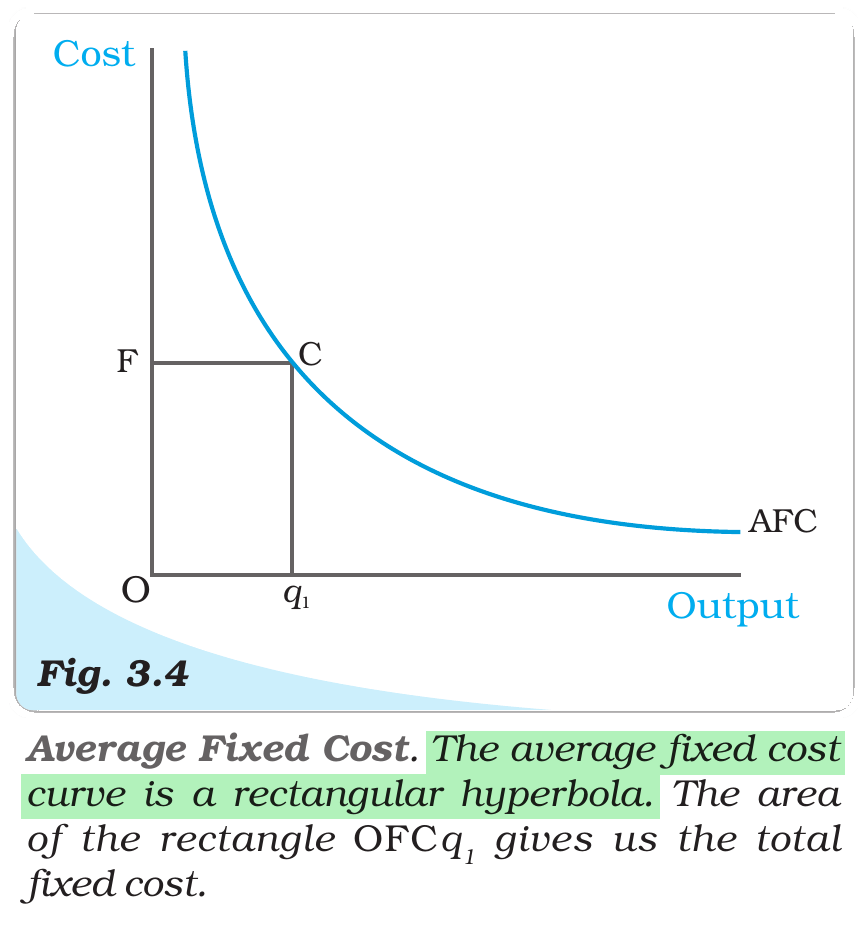
(B) Average fixed cost curve is a downward sloping rectangular hyperbola.
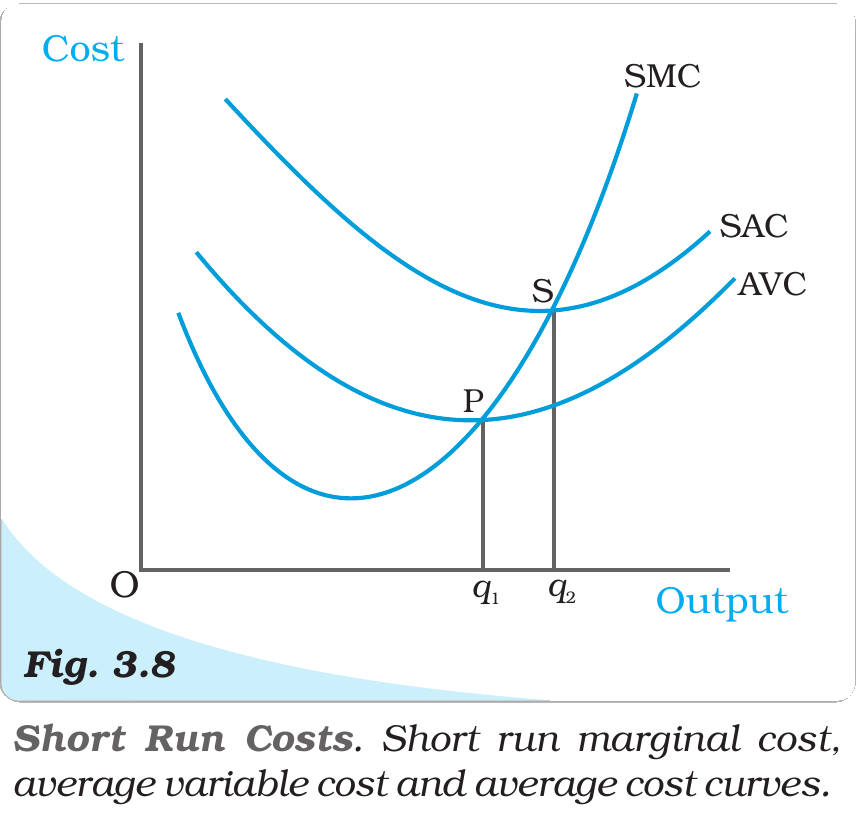
(C) Average variable cost curve is a U shaped curve.
(D) Average variable cost curve and average cost curve are parallel to each other.
Choose the correct answer from the options given below:
Answer & explanation
Correct answer: option 4
The correct answer is Option (4) → (A), (B) and (C) only
(A) Marginal cost is the slope of total variable cost. — True. Marginal cost is the change in total cost when output rises by one unit. Fixed cost does not change with output, so this is the change in total variable cost (TVC) per unit of output. That is the slope of the TVC curve.
(B) Average fixed cost curve is a downward sloping rectangular hyperbola. — True. Average fixed cost (AFC) is total fixed cost divided by output. Total fixed cost is a constant, so as output rises AFC falls. AFC multiplied by output always gives the same constant, which makes the curve a rectangular hyperbola.
(C) Average variable cost curve is a U shaped curve. — True. Marginal cost first falls and then rises. Average variable cost (AVC) falls as long as marginal cost is below it, and it rises once marginal cost is above it. So the AVC curve is U-shaped.
(D) Average variable cost curve and average cost curve are parallel to each other. — False. Average cost equals AVC plus AFC, so the gap between the two curves is AFC. As output rises AFC keeps falling, so the curves move closer together. Parallel curves would keep the same gap.
NCERT (2026-27): “3.7.1 Short Run Costs … Just like the case of marginal product, marginal cost also is undefined at zero level of output. It is important to note here that in the short run, fixed cost cannot be changed. When we change the level of output, whatever change occurs to total cost is entirely due to the change in total variable cost. So in the short run, marginal cost is the increase in TVC due to increase in production of one extra unit of output.… …AFC is the ratio of TFC to q. TFC is a constant. Therefore, as q increases, AFC decreases. When output is very close to zero, AFC is arbitrarily large, and as output moves towards infinity, AFC moves towards zero. AFC curve is, in fact, a rectangular hyperbola. If we multiply any value q of output with its corresponding AFC, we always get a constant, namely TFC.… …For the first unit of output, it is easy to check that SMC and AVC are the same. So both SMC and AVC curves start from the same point. Then, as output increases, SMC falls. AVC being the average of marginal costs, also falls, but falls less than SMC. Then, after a point, SMC starts rising. AVC, however, continues to fall as long as the value of SMC remains less than the prevailing value of AVC. Once the SMC has risen sufficiently, its value becomes greater than the value of AVC. The AVC then starts rising. The AVC curve is therefore ‘U’-shaped.… …SAC is the sum of AVC and AFC. … SAC curve is therefore ‘U’-shaped. It lies above the AVC curve with the vertical difference being equal to the value of AFC. The minimum point of SAC curve lies to the right of the minimum point of AVC curve.…”
|