
CUETMOCK
  • Pricing
  • Mentors
Log inStart freeStart free mocks→

First test, then trust

Try a free CUET mock test.

Join 5,00,000+ students who rehearsed exam day on the exact NTA screen before sitting CUET. On the web and on Android.

Start free mocks →Get the Android app
CUETMOCK

India's #1 CUET Mock Test Platform. Original NCERT-based questions on the exact NTA exam screen — trusted by 5,00,000+ students since CUET 2022.

Get it onGoogle PlayScan to download the CUETMOCK app

Mock tests

  • CUET mock test series
  • Browse all papers
  • Commerce mocks
  • Humanities (Arts) mocks
  • Science mocks
  • Languages & GAT mocks
  • Free practice questions
  • Pricing

Resources

  • CUET exam guide
  • CUET syllabus
  • Universities accepting CUET
  • Expert blogs
  • News & notifications
  • Webinars & counselling
  • CUET score calculator
  • How we estimate your rank
  • FAQs

Company

  • About us
  • Our leadership & team
  • Our toppers
  • Mentors
  • For schools
  • Contact us
  • Terms
  • Privacy
  • Refund policy

Talk to us

+91 7696 6630 56info@cuetmock.comWhatsApp us

Our other platforms

  • JEE Mock — For IIT-JEE aspirants
  • NEET Mock — For NEET aspirants

Newsletter

Exam updates, study material and offers — no spam.

© 2026 NYC Ventures Pvt. Ltd.

701-702, Royal Business Park, Zirakpur, Punjab - 140603

  • Terms of use
  • Privacy policy
  • Refund policy
  • Contact us

iCUETMOCK is an independent preparation platform, not affiliated with the National Testing Agency (NTA). Always check exam details on the official NTA website.

  • Home
  • Mock tests
  • CUET guide
  • Pricing
  • Log in
Home/Practice questions/Physics
PhysicsDual Nature of Radiation and Matter

Consider the following statements about the photoelectrons in this ex…

Read the following passage and answer the questions.

The figure shows the set-up a student uses to study the photoelectric effect. An evacuated glass tube holds a photosensitive plate C (the emitter) and a metal plate A (the collector). Light from a source S enters through a quartz window and falls on plate C. A battery keeps a potential difference between C and A, and she can change its value. A commutator reverses the polarity, so plate A can be made positive or negative with respect to C. A voltmeter reads this potential difference, and a microammeter reads the photocurrent.

She chooses the frequency of the light by placing coloured filters in its path. She changes the intensity by moving the source nearer to or farther from plate C. For each setting, she records the microammeter reading as the potential of A is changed from a large positive value to negative values.
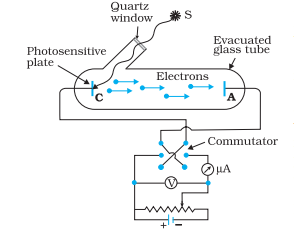
Figure for the question

Consider the following statements about the photoelectrons in this experiment:

(A) The electrons that leave plate C do not all have the same kinetic energy.

(B) When the light is made very dim, emission starts only after a noticeable time lag.

(C) The work function of plate C becomes smaller if light falls on it for a longer time.

(D) The photocurrent is directly proportional to the number of photoelectrons emitted per second.

Choose the correct answer from the options given below:

Answer & explanation+

Correct answer: option 2

The correct answer is Option (2) → (A) and (D) only

Light above the threshold frequency gives out photoelectrons from plate C at once. The current they carry is then read on the microammeter.

(A) The electrons that leave plate C do not all have the same kinetic energy. — True. The kinetic energies range from zero up to a maximum value. Electrons that are held more tightly in the metal come out with less than the maximum kinetic energy.

(B) When the light is made very dim, emission starts only after a noticeable time lag. — False. Above the threshold frequency, emission starts in about \( 10^{-9}\ \mathrm{s} \) or less, even in very dim light. Dim light only gives fewer electrons.

(C) The work function of plate C becomes smaller if light falls on it for a longer time. — False. The threshold frequency \( \nu_0=\phi_0/h \) does not change with the time for which light falls on the plate. So the work function stays the same.

(D) The photocurrent is directly proportional to the number of photoelectrons emitted per second. — True. Each electron that reaches A adds its charge to the current. More electrons per second give a larger photocurrent in the same proportion.

NCERT (2026-27):
Effect of potential on photoelectric current – “… All the photoelectrons emitted from the metal do not have the same energy. …”


Effect of frequency of incident radiation on stopping potential – “(iv) The photoelectric emission is an instantaneous process without any apparent time lag (~10–9s or less), even when the incident radiation is made exceedingly dim.”


Einstein’s Photoelectric Equation: Energy Quantum of Radiation – “… Thus, there exists a threshold frequency ν0 (= φ0/h) for the metal surface, below which no photoelectric emission is possible, no matter how intense the incident radiation may be or how long it falls on the surface.”


Effect of intensity of light on photocurrent – “… The photocurrent is directly proportional to the number of photoelectrons emitted per second. …”

Advertisement

Practise more on Dual Nature of Radiation and Matter

Chapter-wise mocks on the real NTA exam screen, with solutions and your rank. Your first mocks are free.

Start free mocks →

Advertisement

Next questions

  1. The account that records all international transactions of assets is ___________.Economics · Macro Economics: Open Economy Macro Economics
  2. Consider the following Facts about Consumer Protection Act: (A) Getting relief against unfair trade practices by a consumer is called right…Business Studies · Consumer Protection
  3. अकर्मक क्रिया का सही उदाहरण नहीं है-Hindi · व्याकरण - क्रिया
  4. In a certain code ‘HEALING’ is written as ‘CGJLIPK’. How is ‘LOGICAL’ written in that code?General Aptitude Test · Verbal Reasoning
  5. Select the most appropriate meaning of the given idiom On shank's mareEnglish · Grammar: Idioms
  6. The ratio of the outer and the inner circumference of a circular path is 5 : 4. If path is 50 metres wide, then what is the radius of the i…General Aptitude Test · Quantitative Reasoning
  7. In which year did Amrita Sher-Gil paint "Haldi Grinder"?Fine Arts · The Modern Indian Art
  8. Oxidation state of scandium isChemistry · Inorganic: D and F Block Elements
  9. Two different positions of the same dice are shown, the six faces of which are coloured Red, Green, Blue, Yellow, Black, White. Select the…General Aptitude Test · Verbal Reasoning
  10. The height of five students, Aakriti, Kiran, Lisa, Manisha and Rekha, are compared. The height of Kiran is more than only two students. The…General Aptitude Test · Verbal Reasoning