
The figure shows pyran and the Haworth structures of the two cyclic forms of glucose.
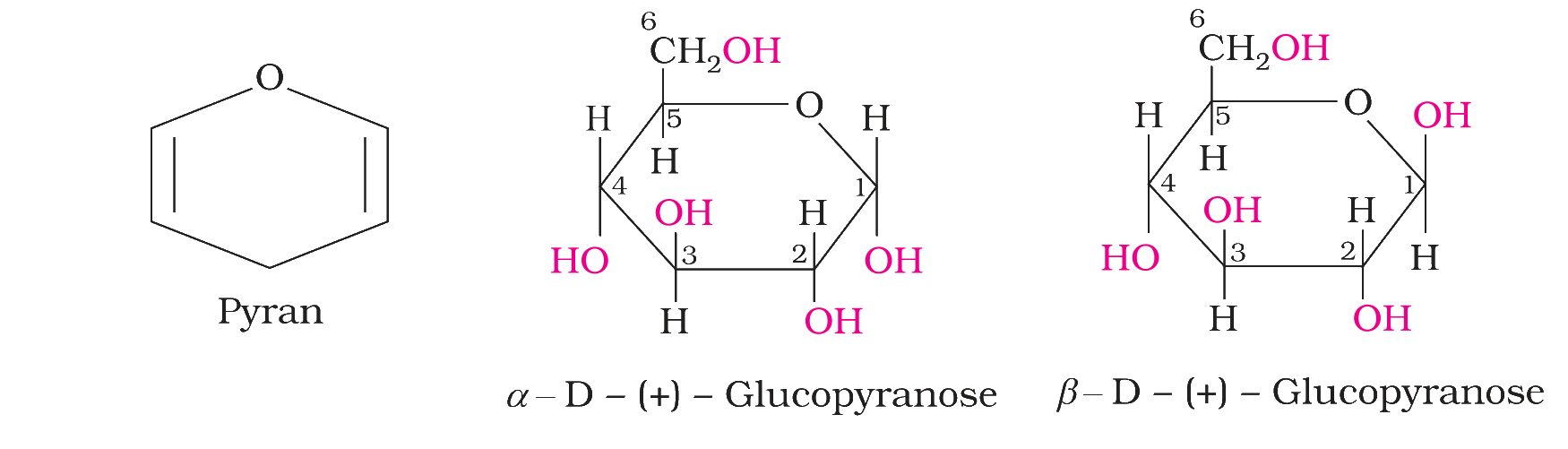
The α- and β-forms shown differ in configuration at only one carbon atom. Which carbon atom is it, and what are such isomers called?
Answer & explanation
Correct answer: option 2
The correct answer is Option (2) → C1; anomers
Glucose forms a six-membered ring when the –OH group at C5 adds to the –CHO group. C1, the aldehyde carbon before ring closure, then carries an –OH group that can lie below or above the ring.
Comparing the two structures — only C1 differs. C2, C3, C4 and C5 carry the same groups on the same sides in both forms; at C1, the α-form has the –OH group below the ring and the β-form has it above the ring.
Name of such isomers — anomers. C1 is called the anomeric carbon, and the α- and β-forms, which differ only at this carbon, are called anomers.
Why the other options are incorrect
Option (1) C5; anomers — Incorrect. In both forms C5 has the CH2OH group above the ring and H below it; its configuration does not change.
Option (3) C1; enantiomers — Incorrect. Enantiomers are mirror images of each other. The two forms differ at C1 only and are the same at every other carbon, so they are not mirror images.
Option (4) C5; enantiomers — Incorrect. The two forms do not differ at C5, and they are not mirror images.
NCERT (2026-27 edition):
10.1.2.1 Glucose – “The two cyclic hemiacetal forms of glucose differ only in the configuration of the hydroxyl group at C1, called anomeric carbon (the aldehyde carbon before cyclisation). Such isomers, i.e., α-form and β-form, are called anomers. The six membered cyclic structure of glucose is called pyranose structure (α– or β–), in analogy with pyran.”
Pyran, α-D-(+)-Glucopyranose and β-D-(+)-Glucopyranose