
Stereoisomers are those isomers that have the same molecular formula and chemical bonds but they have different spatial arrangements of atoms. As already mentioned, stereoisomerism involves two types of isomerism viz., geometrical isomerism and optical isomerism. These are discussed below:
1. Geometrical isomerism
Geometrical isomerism arises in heteroleptic complexes due to ligands occupying different positions around the central ion. The ligands occupy positions either adjacent to one another or opposite to one another. These are referred to as cis-form (ligands occupy adjacent positions) and trans- form (ligands occupy opposite positions). This type of isomerism is, therefore, also referred to as cis-trans isomerism.
2. Optical isomerism
The isomers which rotate the plane of polarised light equally but in opposite directions are called optically active isomers. These are also called enantiomers or enantiomorphs. The d and l isomers are mirror images of each other just as left hand is mirror image of the right hand. These mirror image compounds are non-superimposable on each other and do not possess the plane of symmetry.
A coordination complex of the type MX2Y2 (M = metal ion; X and Y are monodentate ligands) can have either a tetrahedral or a square planar geometry. The maximum numbers of possible isomers in these two cases are, respectively,
Answer & explanation
Correct answer: option 1
The correct answer is Option (1) → 1 and 2
Geometrical (cis-trans) isomers differ in whether two like ligands sit adjacent (cis) or opposite (trans). Optical isomers are mirror images that cannot be superimposed on one another. Count both for MX2Y2 in each shape:
Tetrahedral MX2Y2: all four corners of a tetrahedron are adjacent to one another, so the two X ligands can only be placed one way; no cis or trans form. Its mirror image can be superimposed on it, so there is no optical isomer either. 1 isomer.
Square planar MX2Y2: the two X ligands can be adjacent (cis) or opposite (trans), as in cis- and trans-\( \ce{[Pt(NH3)2Cl2]} \). Each flat form can be superimposed on its mirror image, so neither form is optically active. 2 isomers.
Total: 1 (tetrahedral) and 2 (square planar).
NCERT (2026-27 edition):
5.4.1 Geometric Isomerism
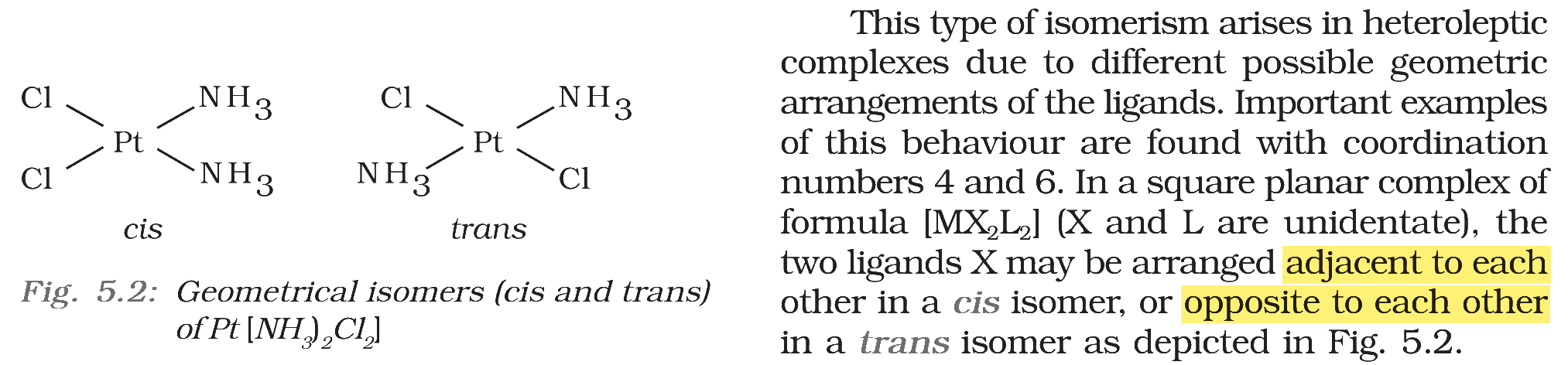
Example 5.4 – “Tetrahedral complexes do not show geometrical isomerism because the relative positions of the unidentate ligands attached to the central metal atom are the same with respect to each other.”
5.4.2 Optical Isomerism – “Optical isomers are mirror images that cannot be superimposed on one another. These are called as enantiomers.”