Match List I with List II
| LIST-I (Fundamental Rights) | LIST-II (Article No.) | ||
| A. | Right to Expression | I. | Article 21 |
| B. | Prohibition of discrimination | II. | Article 19 (i) a |
| C. | Right to Equality | III. | Article 15 |
| D. | Right to life and liberty | IV. | Article 14 |
Choose the correct answer from the options given below:
Answer & explanation
Correct answer: option 1
The correct answer is Option (1) → A-II, B-III, C-IV, D-I
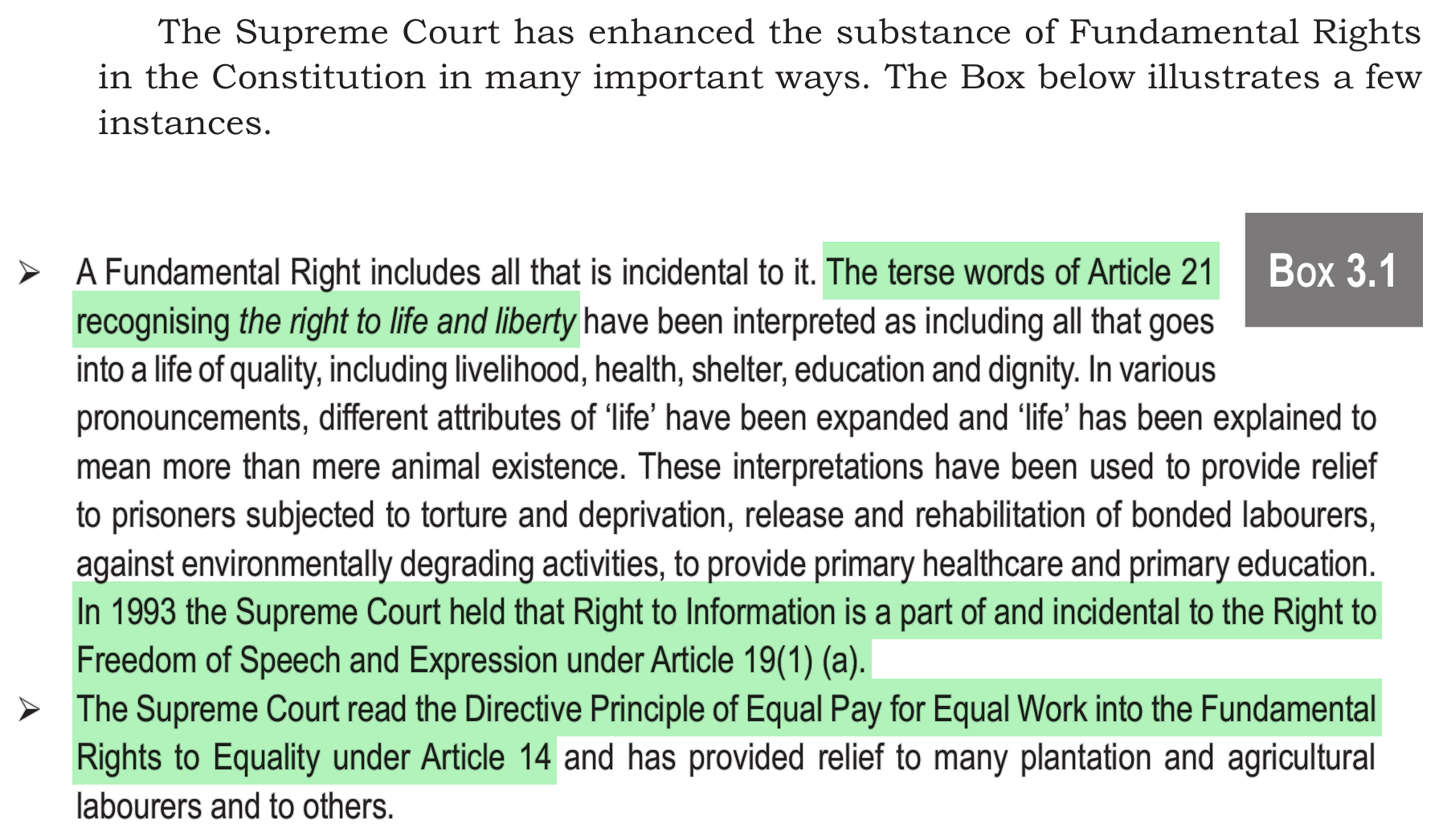
(A) Right to Expression — this matches (II) Article 19 (i) a. In 1993 the Supreme Court held that the Right to Information is a part of the Right to Freedom of Speech and Expression under Article 19(1)(a).
(B) Prohibition of discrimination — this matches (III) Article 15. Article 15 forbids the State to discriminate against any citizen on grounds only of religion, race, caste, sex or place of birth.
(C) Right to Equality — this matches (IV) Article 14. The Supreme Court read the Directive Principle of Equal Pay for Equal Work into the Fundamental Right to Equality under Article 14.
(D) Right to life and liberty — this matches (I) Article 21. The terse words of Article 21 recognising the right to life and liberty have been interpreted to include all that goes into a life of quality, such as livelihood, health, shelter, education and dignity.
Note 1: The chapter ‘The Story of Indian Democracy’ of the pre-rationalised NCERT, which NTA followed in 2023, has been renamed ‘The Constitution and Social Change’ in the NCERT book (2025-26). Its box on how the Supreme Court has widened the Fundamental Rights under Articles 14, 19(1)(a) and 21 is still there.
Note 2: Article 15 of item B is not in NCERT (2025-26); explained here for the benefit of the students.
NCERT: Social Change and Development in India — Chapter 3: The Constitution and Social Change, Box 3.1 (2025-26)
|