Ms Suman's real income rises as a result of fall in price of sugar in the market. As a result, she now purchases more quantity of sugar than before. This phenomenon will be termed as ________.
Answer & explanation
Correct answer: option 3
The correct answer is Option (3) → Expansion in demand
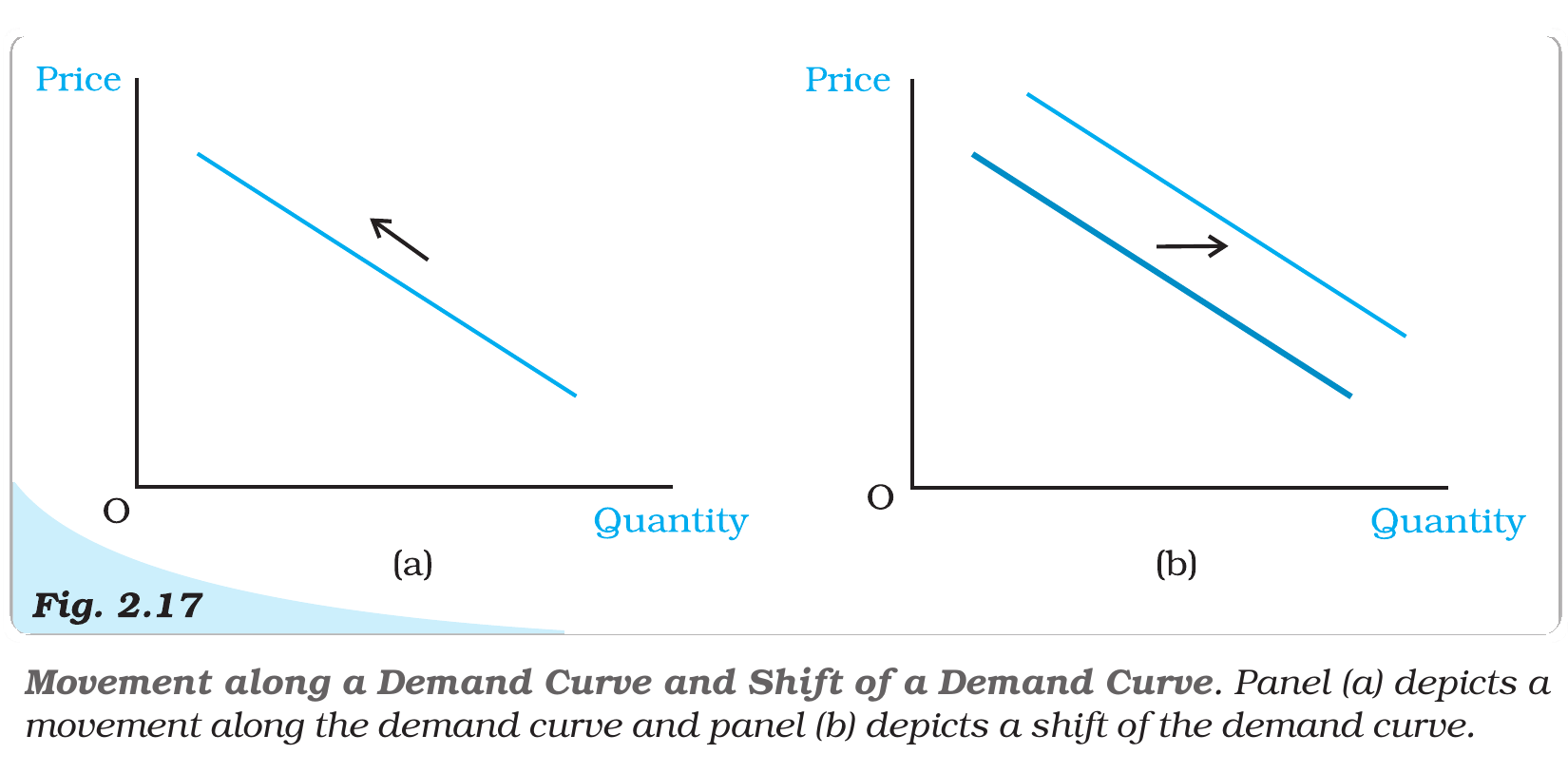
Ms Suman buys more sugar because the price of sugar itself has fallen. Her real income rises only as a result of that fall. A change in a good’s own price leads to a movement along the demand curve. A rise in quantity along the curve is called expansion in demand.
Option (1) Increase in demand — Incorrect. Here more is bought at the same price, for a reason such as higher money income. The demand curve shifts to the right.
Option (2) Decrease in demand — Incorrect. Here less is bought at the same price. The demand curve shifts to the left.
Option (3) Expansion in demand — Correct. The quantity rises because the own price falls.
Option (4) Contraction in demand — Incorrect. The quantity falls along the same curve because the own price rises.
Note: None of the NCERT books (2026-27, 2025-26, 2023-24 or pre-rationalised) uses the words ‘expansion in demand’ or ‘contraction in demand’. They call both a movement along the demand curve.
NCERT (2026-27): “2.4.2 Deriving a Demand Curve from Indifference Curves and Budget Constraints … The negative slope of the demand curve can also be explained in terms of the two effects namely, substitution effect and income effect that come into play when price of a commodity changes. When bananas become cheaper, the consumer maximises his utility by substituting bananas for mangoes in order to derive the same level of satisfaction of a price change, resulting in an increase in demand for bananas. Moreover, as price of bananas drops, consumer’s purchasing power increases, which further increases demand for bananas (and mangoes). This is the income effect of a price change, resulting in further increase in demand for bananas. 2.4.6 Movements along the Demand Curve and Shifts in the Demand Curve … At higher prices, the demand is less, and at lower prices, the demand is more. Thus, any change in the price leads to movements along the demand curve. On the other hand, changes in any of the other things lead to a shift in the demand curve. Figure 2.17 illustrates a movement along the demand curve and a shift in the demand curve.”
|