
For the reaction \( \ce{2NO(g) + O2(g) -> 2NO2(g)} \), the table gives the initial rate of formation of NO2 for different initial concentrations of NO and O2 at the same temperature.
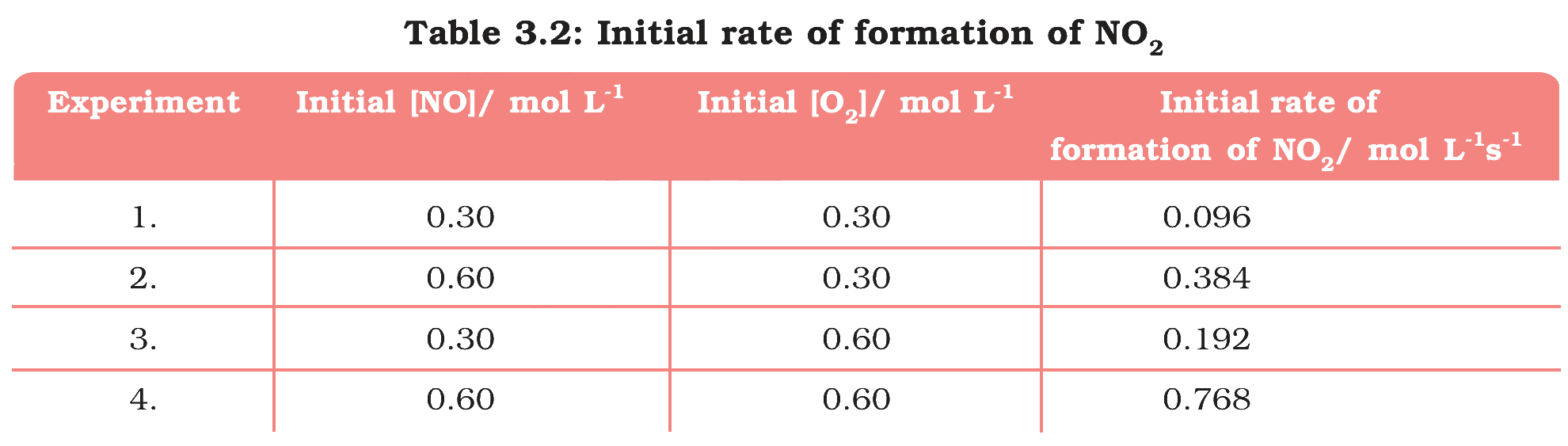
Using experiments 1 and 4 only, what is the overall order of the reaction?
Answer & explanation
Correct answer: option 2
The correct answer is Option (2) → 3
From experiment 1 to experiment 4, both [NO] and [O2] are doubled (0.30 → 0.60 mol L−1). If the order of the reaction (x + y) is n, the rate changes by a factor of 2n.
\( \displaystyle \frac{\text{Rate}_4}{\text{Rate}_1} = \frac{0.768}{0.096} = 8 = 2^{n} \)
\( \displaystyle 2^{n} = 2^{3} \Rightarrow n = 3 \)
NCERT (2026-27 edition):
3.2.2 Rate Expression and Rate Constant – “… This indicates that the rate depends upon the square of the concentration of NO. When concentration of NO is kept constant and concentration of O2 is doubled the rate also gets doubled indicating that rate depends on concentration of O2 to the first power. Hence, the rate equation for this reaction will be Rate = k [NO]2[O2]”
3.2.3 Order of a Reaction – “Sum of these exponents, i.e., x + y in (3.4) gives the overall order of a reaction whereas x and y represent the order with respect to the reactants A and B respectively.”
Table 3.2: Initial rate of formation of NO2