The compound which produces turbidity immediately with Lucas reagent is
Answer & explanation
Correct answer: option 1
The correct answer is Option (1) → \((CH_3)_3C-OH\)
Lucas reagent is concentrated HCl with anhydrous \( \ce{ZnCl2} \). Zinc chloride, a Lewis acid, helps the –OH group leave, and the reaction goes through a carbocation. The more stable the carbocation, the faster the reaction, so the speed follows the class of the alcohol: tertiary > secondary > primary.
2-Methylpropan-2-ol (tert-butyl alcohol) gives the stable tertiary carbocation, so it forms the chloride at once:
\( \displaystyle \ce{(CH3)3C-OH + HCl} \xrightarrow[\text{room temp.}]{\text{anhyd. }\ce{ZnCl2}} \ce{(CH3)3C-Cl + H2O} \)
So the compound that gives turbidity immediately is the tertiary alcohol, \( \ce{(CH3)3C-OH} \).
Why the other options are incorrect
Option (2) \((CH_3)_2CH-OH\) — Incorrect. Propan-2-ol is a secondary alcohol; its carbocation is less stable, so turbidity appears only after about five minutes.
Option (3) \(C_6H_5OH\) — Incorrect. In phenol the C–O bond has partial double bond character (the oxygen lone pair is in resonance with the ring), so it is not broken by Lucas reagent and no chloride forms.
Option (4) \(CH_3CH_2-OH\) — Incorrect. Ethanol is a primary alcohol; it gives no turbidity at room temperature and reacts only on heating.
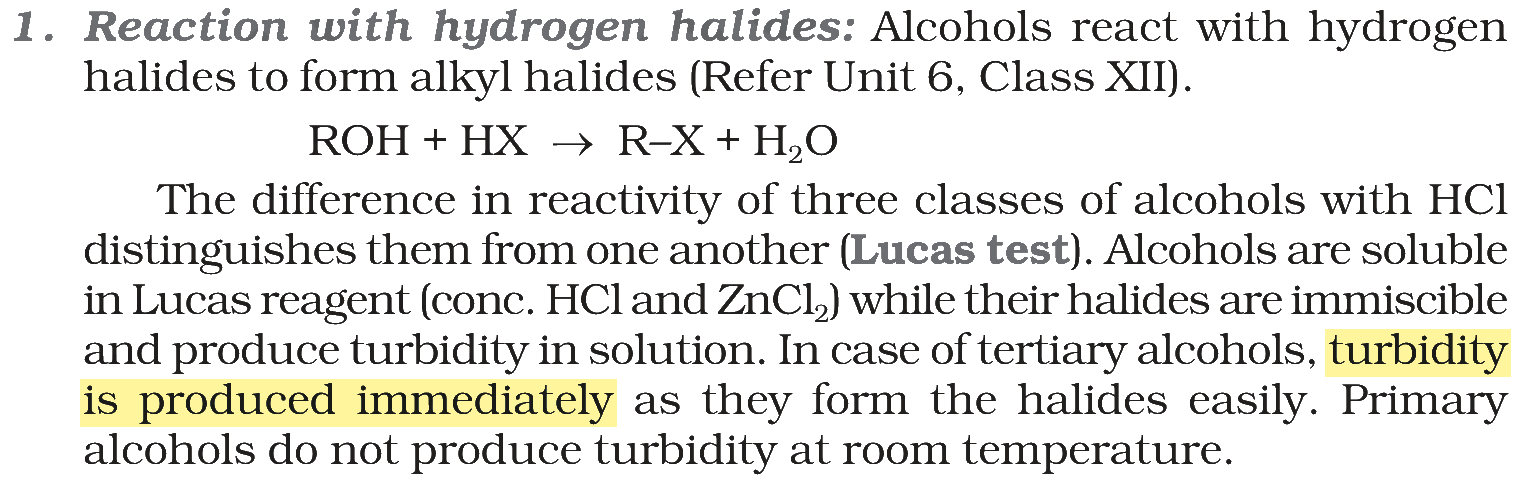
NCERT (2026-27 edition):
Reaction with Hydrogen Halides