If a copper wire carries a direct current, the magnetic field associated with the current would be:
Answer & explanation
Correct answer: option 2
The correct answer is Option (2) → Only outside the wire
Note: The given answer is as per the official NTA Answer Key. However, there seems to be a mistake in the key: the magnetic field exists inside the wire too, so the correct answer should be Option (3), as explained below.
Working as per the NTA key
It seems that NTA has assumed that the whole current flows on the surface of the wire, as it would in a thin hollow tube. Applying Ampere's law to a circular loop of radius \( r \) about the axis:
\( \text{Inside } (r \lt R): \ I_{\mathrm{enc}} = 0 \;\Rightarrow\; B = 0 \)
\( \text{Outside } (r \gt R): \ I_{\mathrm{enc}} = I \)
\( \displaystyle B = \frac{\mu_0 I}{2\pi r} \)
On this assumption the field is only outside the wire, which gives Option (2).
Working as per the standard method
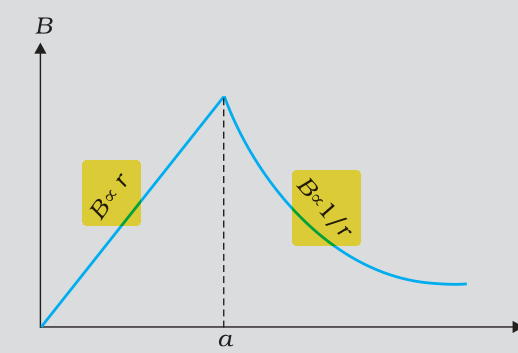
A steady (direct) current in a solid copper wire of radius \( R \) is spread uniformly over its cross-section. Ampere's law, \( \oint \vec{B}\cdot d\vec{l} = \mu_0 I_{\mathrm{enc}} \), is applied to a circular loop of radius \( r \).
Inside the wire (\( r \lt R \)): the loop encloses only the fraction \( r^{2}/R^{2} \) of the current.
\( \displaystyle B\,(2\pi r) = \mu_0 I\,\frac{r^{2}}{R^{2}} \;\Rightarrow\; B = \frac{\mu_0 I r}{2\pi R^{2}} \)
Outside the wire (\( r \gt R \)): the whole current is enclosed.
\( \displaystyle B = \frac{\mu_0 I}{2\pi r} \)
The field is zero only on the axis; it grows linearly inside the wire up to the surface and then falls as \( 1/r \) outside. So the magnetic field exists both inside and outside the wire, which is Option (3). Hence, as per the standard method, the correct answer is Option (3).
NCERT (2026-27):
Ampere’s Circuital Law – …