How is Prisoner's Dilemma used to study cooperation and competition?
A. They are separately offered a chance to confess.
B. If both confess the punishment to both will be mild.
C. Two suspects are quizzed by detectives separately.
D. The one who confesses will get no punishment and the other will be punished.
E. In the end if neither confesses, each will receive a light sentence.
Choose the correct answer from the options given below:
Answer & explanation
Correct answer: option 3
The correct answer is Option (3) → CADBE
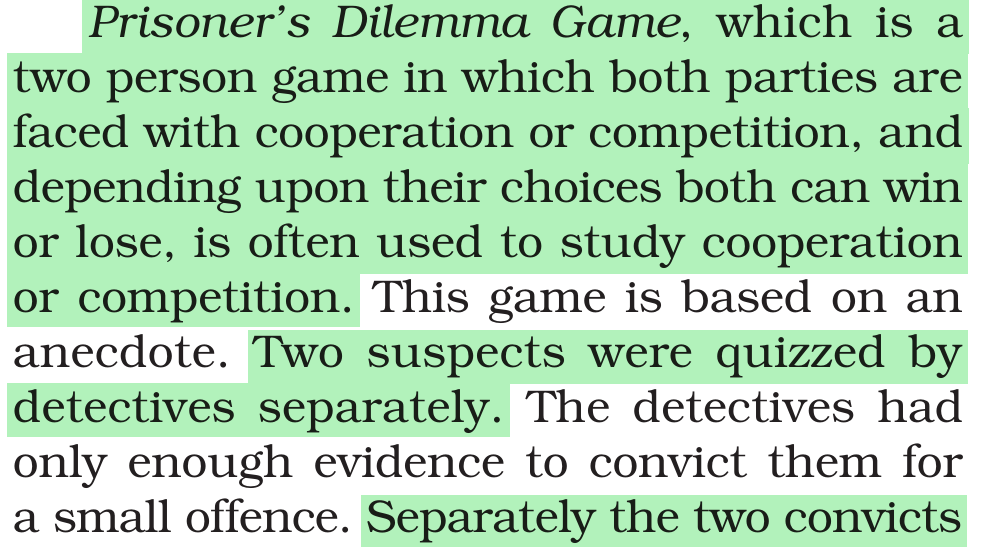
The Prisoner’s Dilemma Game is a two-person game in which both parties are faced with cooperation or competition, and depending on their choices both can win or lose. It is based on an anecdote that runs in this order:
C. Two suspects are quizzed by detectives separately. — the story begins with the two suspects questioned apart; the detectives have only enough evidence to convict them for a small offence.
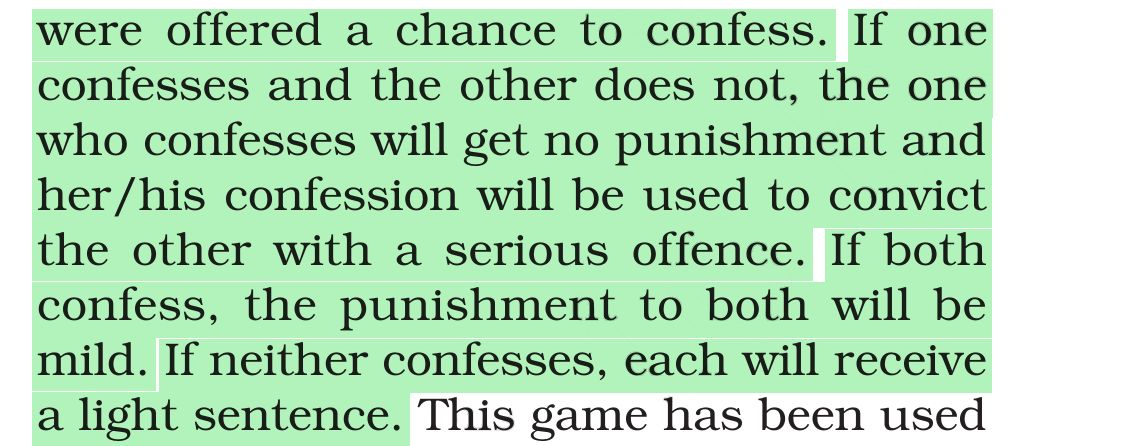
A. They are separately offered a chance to confess. — each is given the same choice on his or her own.
D. The one who confesses will get no punishment and the other will be punished. — the first outcome: if one confesses and the other does not, the confession is used to convict the other of a serious offence.
B. If both confess the punishment to both will be mild. — the second outcome.
E. In the end if neither confesses, each will receive a light sentence. — the last outcome. Each suspect gains most by confessing, yet both do better by trusting each other, which is the conflict between the motive to cooperate and the motive to compete that the game is used to study.
Note: The Prisoner’s Dilemma game, used to study cooperation and competition, was there in the chapter ‘Social Influence and Group Processes’ of the pre-rationalised NCERT, which NTA followed in 2023, and is not there in the NCERT book (2025-26).
NCERT: Psychology — Chapter 7: Social Influence and Group Processes, Cooperation and Competition (Pre-rationalised)
|