
Match List-I with List-II
|
List-I |
List-II |
|
Materials |
Conductivity $(S m)^{-1}$ |
|
(A) Gold |
$ \text{(I) }1.0\times10^{-16} $ |
|
(B) Germanium |
$ \text{(II) }1.2\times10 $ |
|
(C) Glass |
$ \text{(III) }4.5\times10^3$ |
|
(D) Graphite |
$ \text{(IV) }2.0 $ |
Choose the correct answer from the options given below:
Answer & explanation
Correct answer: option 4
The correct answer is Option (4) → (A) - (III), (B) - (IV), (C) - (I), (D) - (II)
|
List-I |
List-II |
|
Materials |
Conductivity $(S m)^{-1}$ |
|
(A) Gold |
$ \text{(III) }4.5\times10^3 $ |
|
(B) Germanium |
$ \text{(IV) }2.0 $ |
|
(C) Glass |
$ \text{(I) }1.0\times10^{-16} $ |
|
(D) Graphite |
$ \text{(II) }1.2\times10 $ |
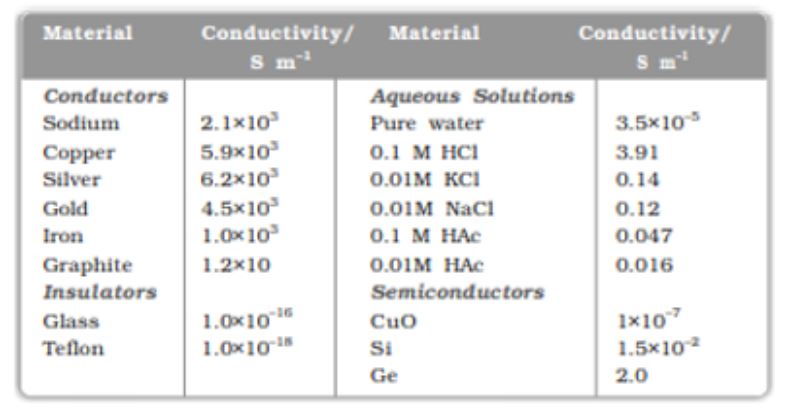
Electrical conductivity (o) is a fundamental property of a material that quantifies its ability to allow the flow of an electric current. It is the reciprocal of electrical resistivity.SI Unit: Siemens per metre (S/m).Materials are classified based on their conductivity levels:
Conductors: Have high conductivity due to a high density of free charge carriers (e.g., metals).
Semiconductors: Have intermediate conductivity that can be manipulated by temperature or impurities (e.g., silicon, germanium).
Insulators: Have very low conductivity as their electrons are tightly bound (e.g., rubber, glass, pure water).
Conductivity varies widely depending on whether the material is a conductor, semiconductor or insulator.
Conductivity of Materials
|
Material |
Conductivity (S/m) |
Description |
|
Silver |
$6.3 \times 10^7$ |
Best known conductor |
|
Copper |
$5.8 \times 10^7$ |
Most used for wiring due to cost/efficiency |
|
Gold |
$4.1 \times 10^7$ |
Used for corrosion-resistant contacts |
|
Seawater |
$\approx 5$ |
Conductive due to dissolved salts |
|
Rubber |
$\approx 10^{-14}$ |
Strong insulator |
Detailed Explanation: Gold
Gold is an excellent conductor.
Hence it has very high conductivity.
In the provided matching context:
Matches with: $4.5 \times 10^3$
$(A) \rightarrow (III)$.
Germanium
Germanium is a semiconductor.
Its conductivity is moderate.
Matches with: $2.0$
$(B) \rightarrow (IV)$
Glass
Glass is an insulator.
Its conductivity is extremely low.
Matches with: $1.0 \times 10^{-16}$
$(C) \rightarrow (I)$
Graphite
Graphite conducts due to delocalized electrons.
But less than metals.
Matches with: $1.2 \times 10$
$(D) \rightarrow (II)$