
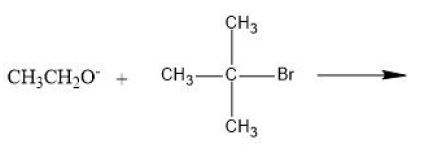
Identify the product of the following reaction
Answer & explanation
Correct answer: option 3
The correct answer is Option (3) → 2-methylpropene (\( \ce{(CH3)2C=CH2} \))
An alkoxide ion is both a nucleophile and a strong base. With a primary alkyl halide it substitutes (Williamson synthesis) and gives an ether. With a tertiary alkyl halide the carbon carrying the halogen is too crowded for \(S_N2\) attack, so the alkoxide removes a β-hydrogen instead and an alkene is the only product (elimination):
\( \displaystyle \ce{CH3CH2O^- + (CH3)3C-Br -> (CH3)2C=CH2 + CH3CH2OH + Br-} \)
So the product is 2-methylpropene.
Why the other options are incorrect
Option (1) tert-butyl ethyl ether (\( \ce{CH3CH2O-C(CH3)3} \)) — Incorrect. This ether would need substitution at the tertiary carbon. It is made the other way round, from the bulky alkoxide and the primary halide:
\( \displaystyle \ce{(CH3)3C-O^-Na+ + CH3CH2Br -> (CH3)3C-O-CH2CH3 + NaBr} \)
Option (2) ethene (\( \ce{H2C=CH2} \)) — Incorrect. Ethene would come from elimination on the ethyl group, but the ethyl group here is in the base, not in the halide.
Option (4) \(CH_3CH_2Br\) — Incorrect. No bromine is transferred to the ethyl group; bromine leaves as \( \ce{Br-} \).
NCERT (2026-27 edition):
Williamson Synthesis – …
