Alcohols
Alcohols are formed when a hydrogen atom in aliphatic hydrocarbon is replaced by –OH group. Alcohols are classified as primary, secondary and tertiary alcohols depending on the attachment of –OH group to primary, secondary and tertiary carbon atom, respectively. In alcohols, the oxygen of the –OH group is attached to carbon by a sigma (σ) bond formed by the overlap of a sp3 hybridised orbital of carbon with a sp3 hybridised orbital of oxygen. Alcohols consist of two parts, an alkyl group and a hydroxyl group. The properties of alcohols are chiefly due to the hydroxyl group. The nature of alkyl groups simply modify these properties. The boiling points of alcohols increase with increase in the number of carbon atoms (increase in van der Waals forces). In alcohols, the boiling points decrease with increase of branching in carbon chain (because of decrease in van der Waals forces with decrease in surface area). Alcohols undergo dehydration (removal of a molecule of water) to form alkenes on treating with a protic acid e.g., concentrated H2SO4 or H3PO4, or catalysts such as anhydrous zinc chloride or alumina. Alcohols are versatile compounds. They act both as nucleophiles and electrophiles. An alcohol with molecular formula C4H10O (A) is prepared by the reduction of corresponding ketone. A is also prepared by the reaction of propanal with methylmagnesium bromide followed by hydrolysis. Compound A on dehydration gives alkene (B).
Which reagent is used for reduction of ketone to compound “A”?
Answer & explanation
Correct answer: option 3
The correct answer is Option (3) → LiAlH4/H3O+
First identify A. A Grignard reagent adds to the C=O group of an aldehyde, and hydrolysis of the adduct gives an alcohol. Methanal gives a 1° alcohol, other aldehydes give 2° alcohols, and ketones give 3° alcohols. Propanal with methylmagnesium bromide therefore gives butan-2-ol (\( \ce{C4H10O} \)):
\( \displaystyle \ce{CH3CH2CHO + CH3MgBr -> CH3CH2CH(OMgBr)CH3} \)
\( \displaystyle \ce{CH3CH2CH(OMgBr)CH3 + H2O -> CH3CH2CH(OH)CH3 + Mg(OH)Br} \)
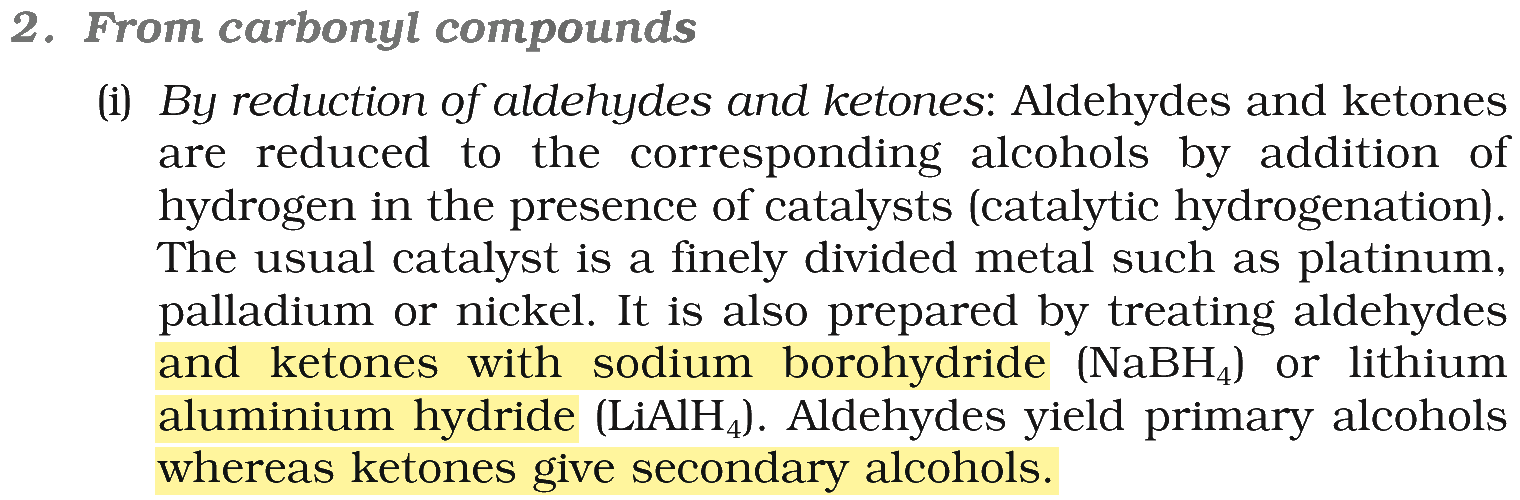
The “corresponding ketone” of butan-2-ol is butan-2-one. Ketones are reduced to secondary alcohols by hydride reducing agents such as lithium aluminium hydride (or \( \ce{NaBH4} \)), followed by acidic work-up, or by catalytic hydrogenation:
\( \displaystyle \ce{CH3COCH2CH3} \xrightarrow[\text{(ii) }\ce{H3O^+}]{\text{(i) }\ce{LiAlH4}} \ce{CH3CH(OH)CH2CH3} \)
So the reagent used is LiAlH4/H3O+.
Why the other options are incorrect
Option (1) Zn/Hg-HCl — Incorrect. This is the Clemmensen reduction; it reduces C=O all the way to \( \ce{CH2} \), so butan-2-one would give butane, not an alcohol:
\( \displaystyle \ce{CH3COCH2CH3 + 4[H]} \xrightarrow{\ce{Zn-Hg}/\text{conc. }\ce{HCl}} \ce{CH3CH2CH2CH3 + H2O} \)
Option (2) CrO3 — Incorrect. It is an oxidising agent; it converts a secondary alcohol into a ketone, the reverse of what is needed:
\( \displaystyle \ce{CH3CH(OH)CH2CH3} \xrightarrow{\ce{CrO3}} \ce{CH3COCH2CH3} \)
Option (4) Sn/HCl — Incorrect. It is used to reduce aromatic nitro compounds to amines, not ketones to alcohols.
NCERT (2026-27 edition):
From Carbonyl Compounds