Match List-I with List-II
| List-I | List-II |
| (A) Price-takers | (I) Break-even point. |
| (B) Price less than minimum point of AVC curve | (II) Normal profit. |
| (C) A firm earns normal profit | (III) Perfectly Competitive Market. |
| (D) A firm covers the explicit costs and opportunity costs | (IV) Shut down point. |
Choose the correct answer from the options given below:
Answer & explanation
Correct answer: option 4
The correct answer is Option (4) → (A) - (III), (B) - (IV), (C) - (I), (D) - (II)
Under perfect competition a firm has no say over the market price; what it decides is how much to produce, and whether to produce at all. That depends on which costs the price covers: average variable cost decides the shut-down point, and average cost, normal profit included, decides the break-even point.
(A) Price-takers — this matches (III) Perfectly Competitive Market. In perfect competition there are a large number of firms selling an identical product, so no single firm can change the market price by changing its own output. Each firm accepts the market price as given, which is what being a price-taker means.
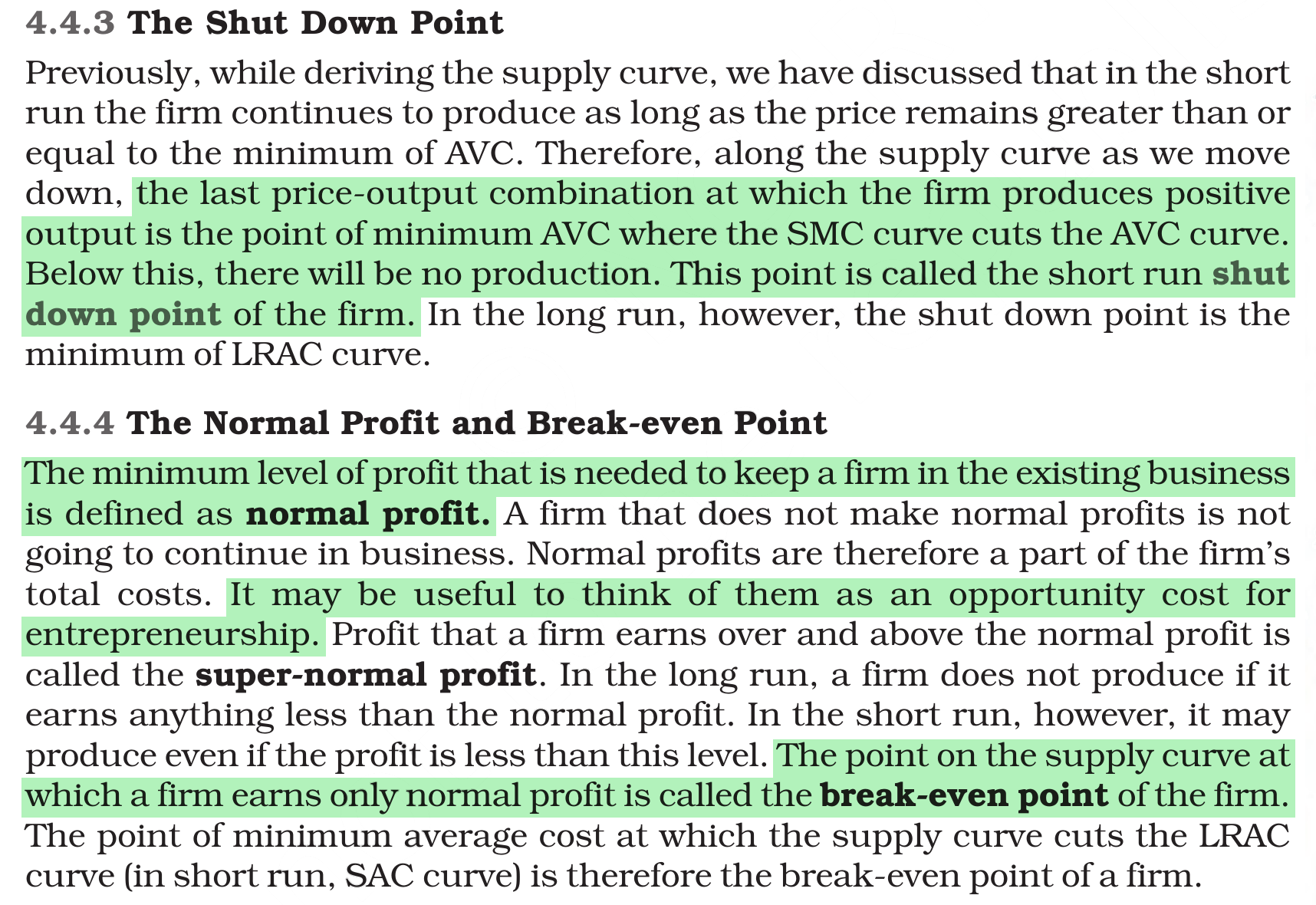
(B) Price less than minimum point of AVC curve — this matches (IV) Shut down point. In the short run a firm keeps producing as long as the price is at least equal to the minimum of average variable cost. The last price at which it still produces is the minimum point of AVC, where the SMC curve cuts the AVC curve; this is the short run shut down point. At any price below it the firm does not even cover its variable cost, so it produces nothing.
(C) A firm earns normal profit — this matches (I) Break-even point. The point on the supply curve at which a firm earns only normal profit is called its break-even point. It lies at the minimum of average cost, where the price just covers average cost.
(D) A firm covers the explicit costs and opportunity costs — this matches (II) Normal profit. Normal profit is the minimum profit needed to keep a firm in its existing business, and it is counted as part of the firm’s total cost, as the opportunity cost of entrepreneurship. A firm whose revenue covers its explicit costs and this opportunity cost is earning normal profit.
Note: Two items of List-I can be matched with more than one entry of List-II:
(C) A firm earns normal profit → both (I) Break-even point and (II) Normal profit. The break-even point is defined as the point at which a firm earns only normal profit, and the item itself names normal profit.
(D) A firm covers the explicit costs and opportunity costs → both (II) Normal profit and (I) Break-even point. Covering the opportunity cost of entrepreneurship along with the explicit costs is earning normal profit, and the point at which a firm does just this is its break-even point.
NCERT: Introductory Microeconomics — Chapter 4: The Theory of the Firm under Perfect Competition (2025-26)
|