
In the depression of freezing point experiment, it is found that:
A. The vapour pressure of the solution is less than that of pure solvent.
B. The vapour pressure of the solution is more than that of pure solvent.
C. Only solute molecules solidify at the freezing point.
D. Only solvent molecules solidify at the freezing point.
Choose the correct answer from the options given below:
Answer & explanation
Correct answer: option 2
The correct answer is Option (2) → (A) and (D) Only
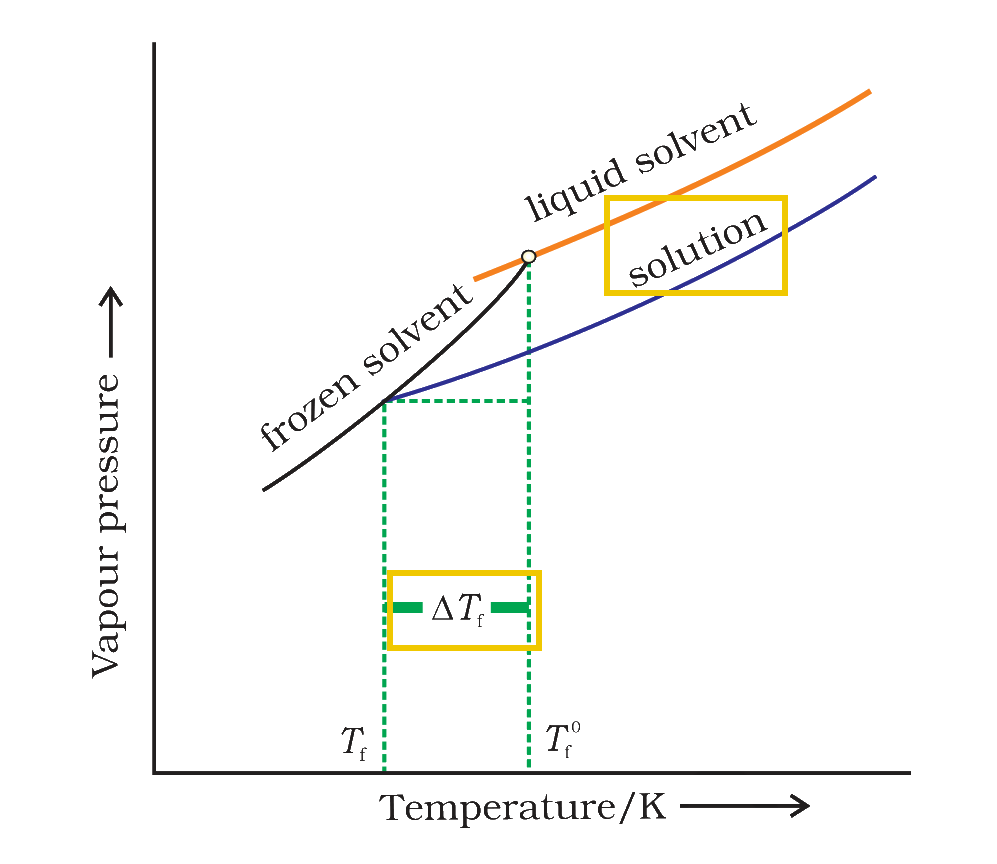
At the freezing point the liquid and solid phases are in equilibrium, i.e. their vapour pressures are equal. A non-volatile solute lowers the vapour pressure of the solvent, so the solution reaches the vapour pressure of the pure solid solvent only at a lower temperature: the freezing point is depressed.
A. The vapour pressure of the solution is less than that of pure solvent — Correct. This lowering of vapour pressure (Raoult’s law) is the cause of the depression.
B. The vapour pressure of the solution is more than that of pure solvent — Incorrect. A non-volatile solute always lowers, never raises, the vapour pressure.
C. Only solute molecules solidify at the freezing point — Incorrect. The solute stays in solution; it is the solvent that freezes out.
D. Only solvent molecules solidify at the freezing point — Correct. The solid that separates is the pure solid solvent (ice from an aqueous solution).
NCERT (2026-27 edition):
Depression of Freezing Point – “… A solution will freeze when its vapour pressure equals the vapour pressure of the pure solid solvent as is clear from Fig. 1.8. According to Raoult’s law, when a non-volatile solid is added to the solvent its vapour pressure decreases and now it would become equal to that of solid solvent at lower temperature. Thus, the freezing point of the solvent decreases.”
Note: The same/similar question has been asked in different years by NTA as per the details given below:
| 2026 | 2025 | 2024 | 2023 | 2022 |
|---|---|---|---|---|
| – | – | – | 14-06 S1 30-05 S2 | – |