Identify Z in the following series:

Answer & explanation
Correct answer: option 2
The correct answer is Option (2) → \(NCCH_2-CH_2CN\)
The series is \( \ce{C2H5I} \xrightarrow{\text{alc. KOH}} \ce{X} \xrightarrow{\ce{Br2}} \ce{Y} \xrightarrow{\ce{KCN}} \ce{Z} \): an elimination, then an addition, then a substitution.
X (ethene): heated with alcoholic KOH, iodoethane loses H from the β-carbon and I from the α-carbon (dehydrohalogenation):
\( \displaystyle \ce{CH3CH2I + KOH} \xrightarrow[\Delta]{\text{alcohol}} \ce{CH2=CH2 + KI + H2O} \)
Y (1,2-dibromoethane): bromine adds across the double bond to give a vic-dibromide:
\( \displaystyle \ce{CH2=CH2 + Br2} \xrightarrow{\ce{CCl4}} \ce{BrCH2-CH2Br} \)
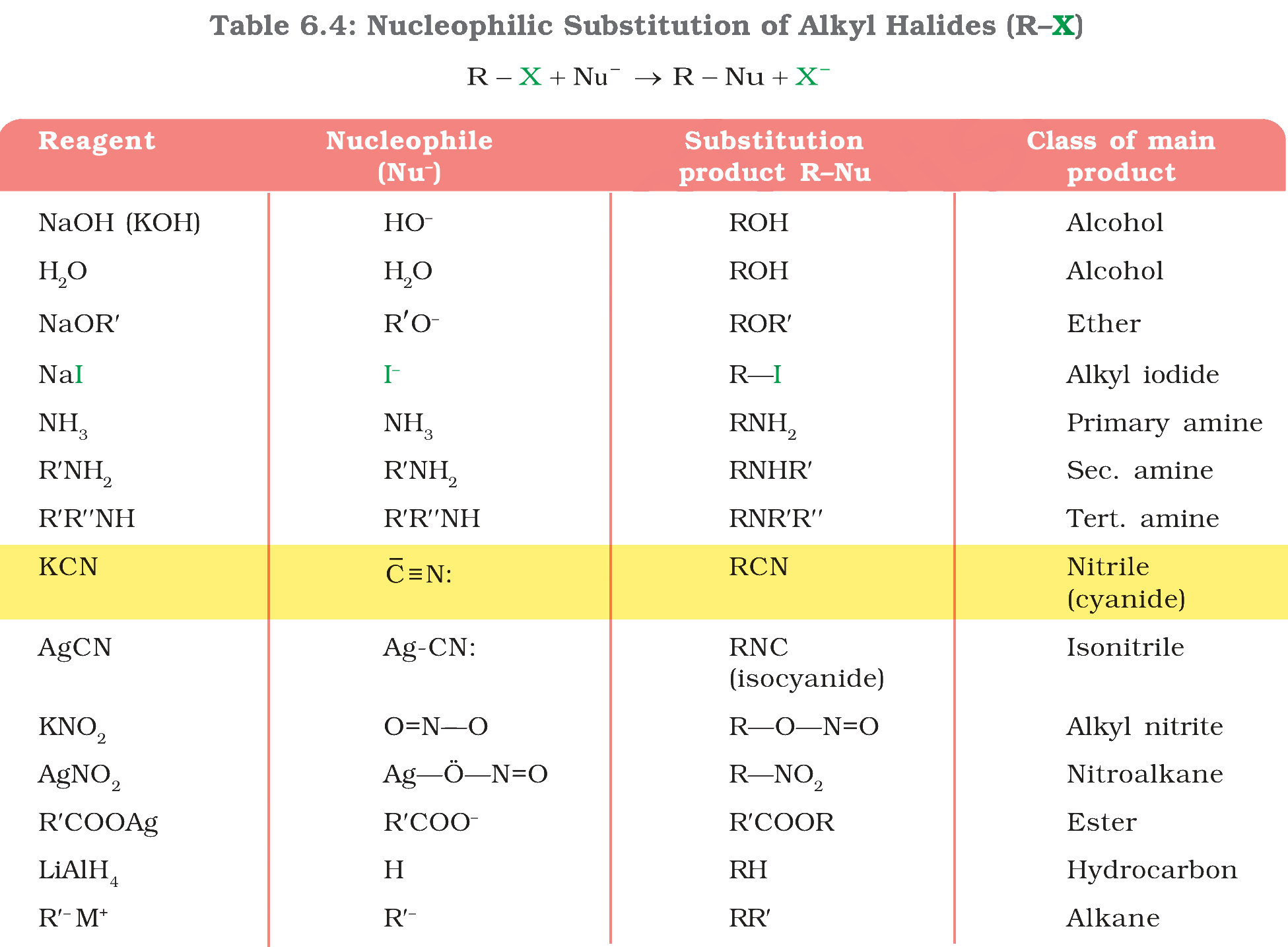
Z (butanedinitrile): the cyanide ion of KCN replaces both bromine atoms by nucleophilic substitution, giving a dinitrile:
\( \displaystyle \ce{BrCH2-CH2Br + 2KCN -> NCCH2-CH2CN + 2KBr} \)
Why the other options are incorrect
Option (1) \(CH_3CH_2CN\) — Incorrect. This is what KCN would give with \( \ce{C2H5I} \) directly; here the alkyl halide is first turned into ethene and then into a dibromide, so two CN groups enter.
Option (3) \(BrCH_2-CH_2Br\) — Incorrect. This is Y, the product of the bromine step; KCN still has to replace its bromine atoms.
Option (4) \(BrCH=CHBr\) — Incorrect. One molecule of \( \ce{Br2} \) adds to ethene and leaves no double bond; besides, Z must contain the CN groups brought in by KCN.
NCERT (2026-27 edition):
6.7.1 Reactions of Haloalkanes – “When a haloalkane with β-hydrogen atom is heated with alcoholic solution of potassium hydroxide, there is elimination of hydrogen atom from β-carbon and a halogen atom from the α-carbon atom. As a result, an alkene is formed as a product.”
6.4.2 From Hydrocarbons – “(ii) Addition of halogens: In the laboratory, addition of bromine in CCl4 to an alkene resulting in discharge of reddish brown colour of bromine constitutes an important method for the detection of double bond in a molecule. The addition results in the synthesis of vic-dibromides, which are colourless (Unit 9, Class XI).”
6.7.1 Reactions of Haloalkanes