CUETMOCK
  • Pricing
  • Mentors
Log inStart freeStart free mocks→

First test, then trust

Try a free CUET mock test.

Join 5,00,000+ students who rehearsed exam day on the exact NTA screen before sitting CUET. On the web and on Android.

Start free mocks →Get the Android app
CUETMOCK

India's #1 CUET Mock Test Platform. Original NCERT-based questions on the exact NTA exam screen — trusted by 5,00,000+ students since CUET 2022.

Get it onGoogle PlayScan to download the CUETMOCK app

Mock tests

  • CUET mock test series
  • Browse all papers
  • Commerce mocks
  • Humanities (Arts) mocks
  • Science mocks
  • Languages & GAT mocks
  • Free practice questions
  • Pricing

Resources

  • CUET exam guide
  • CUET syllabus
  • Universities accepting CUET
  • Expert blogs
  • News & notifications
  • Webinars & counselling
  • CUET score calculator
  • How we estimate your rank
  • FAQs

Company

  • About us
  • Our leadership & team
  • Our toppers
  • Mentors
  • For schools
  • Contact us
  • Terms
  • Privacy
  • Refund policy

Talk to us

+91 7696 6630 56info@cuetmock.comWhatsApp us

Our other platforms

  • JEE Mock — For IIT-JEE aspirants
  • NEET Mock — For NEET aspirants

Newsletter

Exam updates, study material and offers — no spam.

© 2026 NYC Ventures Pvt. Ltd.

701-702, Royal Business Park, Zirakpur, Punjab - 140603

  • Terms of use
  • Privacy policy
  • Refund policy
  • Contact us

iCUETMOCK is an independent preparation platform, not affiliated with the National Testing Agency (NTA). Always check exam details on the official NTA website.

  • Home
  • Mock tests
  • CUET guide
  • Pricing
  • Log in
Home/Practice questions/Economics
EconomicsMicro Economics: Theory of Consumer behaviour

Which of the following indicates a situation of consumer's equilibriu…

Which of the following indicates a situation of consumer's equilibrium for a rational consumer consuming two goods?

Answer & explanation+

Correct answer: option 1

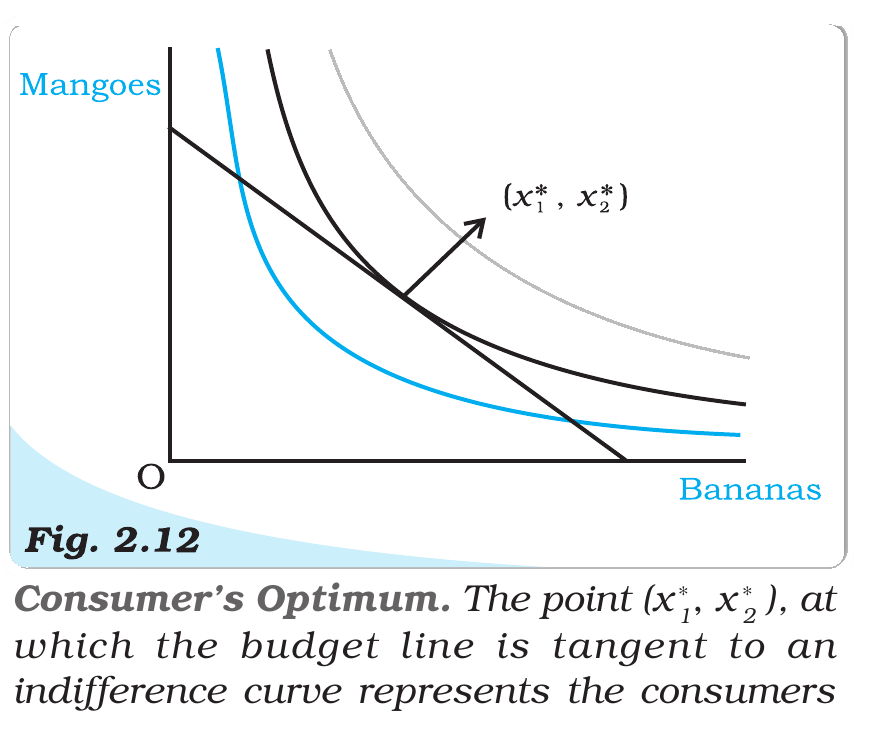
The correct answer is Option (1) → The point at which the budget line just touches (is tangent to), one of the indifference curves.

A rational consumer wants the highest indifference curve her budget allows. An indifference curve joins the bundles she finds equally good. The budget line joins the bundles that cost her whole income. She reaches the highest curve where the budget line just touches it. This point, her optimum bundle, is the consumer’s equilibrium. There, the rate at which she is willing to exchange the goods equals the rate the market allows. The first is the marginal rate of substitution (MRS), the second the price ratio.

  • Option (1) The point at which the budget line just touches (is tangent to), one of the indifference curves. — Correct. At this point the MRS equals the price ratio, so no change can make her better off.

  • Option (2) The absolute value of the slope of the indifference curve (MRS) is greater than that of the budget line (price ratio) at that point. — Incorrect. She is willing to give up more of one good than the market asks. So she can buy more of the other good and move to a preferred bundle.

  • Option (3) A point below the budget line. — Incorrect. Some point on the budget line has more of at least one good and no less of the other. She prefers that point.

  • Option (4) The point at which the consumer spends all his/her income and the budget line intersects one of the indifference curves. — Incorrect. Where the line cuts a curve, the MRS and the price ratio differ. By moving along the budget line, she can reach a higher indifference curve.

NCERT (2026-27): “2.3 Optimal Choice of the Consumer … The optimum point would be located on the budget line. A point below the budget line cannot be the optimum. …

The point at which the budget line just touches (is tangent to), one of the indifference curves would be the optimum.9 To see why this is so, note that any point on the budget line other than the point at which it touches the indifference curve lies on a lower indifference curve and hence is inferior. Therefore, such a point cannot be the consumer’s optimum. The optimum bundle is located on the budget line at the point where the budget line is tangent to an indifference curve.

Equality of the Marginal Rate of Substitution and the Ratio of the Prices The optimum bundle of the consumer is located at the point where the budget line is tangent to one of the indifference curves. If the budget line is tangent to an indifference curve at a point, the absolute value of the slope of the indifference curve (MRS) and that of the budget line (price ratio) are same at that point.…”

NCERT extract

Advertisement

Practise more on Micro Economics: Theory of Consumer behaviour

Chapter-wise mocks on the real NTA exam screen, with solutions and your rank. Your first mocks are free.

Start free mocks →

Advertisement

Next questions

  1. Match the following Places in List I with the description mentioned in List II: List- I (Place) List- II (Description) (A) Shimla (I) Made…History · Modern India: Colonial cities
  2. What is the meaning of the idiom "Bird’s eye view"?English · Grammar: Idioms
  3. The writer’s attitude towards the PIN code can best be described as:English · Comprehension - (Narrative / Factual)
  4. Given below are two statements:Statement I: India had to borrow from the IMF and the World Bank to set right its balance of payments crisis…Economics · Indian Economic Development: Comparative Development Experiences of India and its Neighbours
  5. Orientation is the process of _________ the selected employee to other employees and familiarising him with the rules and policies of the o…Business Studies · Staffing
  6. Let P be the point (3, 4, 12). Match List-I with List-II List-IList-II Distance of P fromValue (A) the x-axis(I) 3 (B) the y-axis(II) 5 (C)…Maths. Section B1 · Three-dimensional Geometry
  7. Name the organization which was founded to prevent the British legislation against Sati.Sociology · Social Change and Development in India: Social Movements
  8. In which state is the archaeological site of Surkotada situated?General Aptitude Test · General Knowledge
  9. Match List-I with List-II on the basis of meaning and the term: List – I (Meaning) List – II (Term) (A) Right to command (I) Answerability…Business Studies · Organising
  10. माता-पिता अपने बच्चों के लिए कड़ी मेहनत करते हैं| 'के-लिए' निम्नलिखित में से क्या है?Hindi · व्याकरण - सकारक