
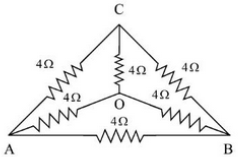
Six equal resistances each of \( 4\,\Omega \) are connected to form a network as shown in figure. The resistance between A and B would be:
Answer & explanation
Correct answer: option 1
The correct answer is Option (1) → \( 2\,\Omega \)
Each of the four points A, B, C and O is joined to every other point by a \( 4\,\Omega \) resistor. Between A and B the network is symmetric: C and O are each joined to A by \( 4\,\Omega \) and to B by \( 4\,\Omega \).
So C and O are at the same potential, and no current flows in the resistor CO. It can be removed.
Three paths then remain between A and B, in parallel:
\( \text{A to B direct: } 4\,\Omega \)
\( \text{A to C to B: } 4 + 4 = 8\,\Omega \)
\( \text{A to O to B: } 4 + 4 = 8\,\Omega \)
\( \displaystyle \frac{1}{R_{AB}} = \frac{1}{4} + \frac{1}{8} + \frac{1}{8} = \frac{1}{2} \)
\( \displaystyle R_{AB} = 2\,\Omega \)